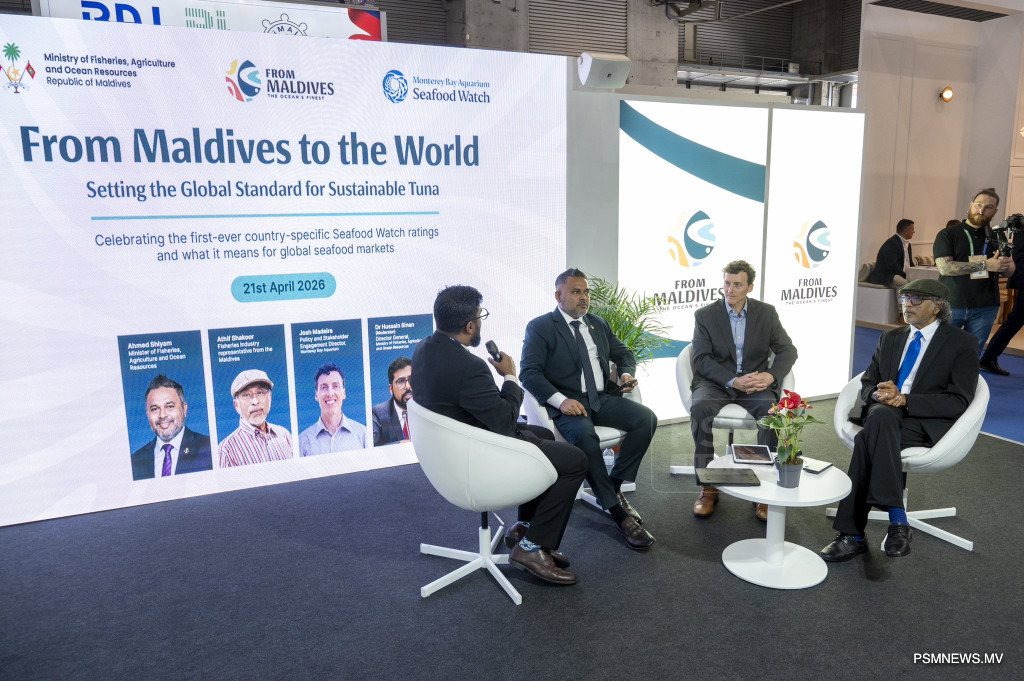
Maldives Showcases Sustainable Tuna Industry at Global Seafood Marketplace 2026
The Maldives has intensified its efforts to elevate its fisheries sector on the world stage during a high-profile presentation at the Global Seafood Marketplace 2026 in Barcelona. Centered around a dedicated panel discussion titled “From Maldives to the World,” the initiative aimed to attract international buyers and highlight the nation's commitment to ocean stewardship.
Leading the delegation was the Minister of Fisheries, Agriculture, and Ocean Resources, Ahmed Shiyam, accompanied by a consortium of the country's leading industry players. Participating companies included the Maldives Fisheries and Ocean Resources Marketing and Promotion Corporation (MFMC), Maldives Industrial Fisheries Company (MIFCO), and several private enterprises such as Horizon Fisheries, Ensis Fisheries, Blue Solutions, and Big Fish Maldives.
The panel, which featured Minister Shiyam alongside strategic consultant Athif Shakoor and Josh Madeira of the Monterey Bay Aquarium, focused on the intersection of sustainability and market expansion. Discussions centered on overcoming logistical challenges, implementing value-addition strategies to increase profit margins, and leveraging sustainable practices to penetrate more demanding global markets.
A primary catalyst for the event was the recent landmark achievement by Maldivian tuna fisheries, which received the prestigious “Best Choice” rating from Seafood Watch. This designation marks a historic first, as it is the first time a specific country’s tuna fishery has been awarded such a rating within the program's history.
This sustainability certification provides the Maldives with a significant competitive advantage. While broader concerns regarding overfishing persist in various regions of the Indian Ocean, the “Best Choice” rating officially positions Maldivian tuna as a preferred, sustainable option for global consumers and distributors. By securing this recognition, the Maldives is not only protecting its marine biodiversity but also ensuring the long-term economic viability of its most vital industry.