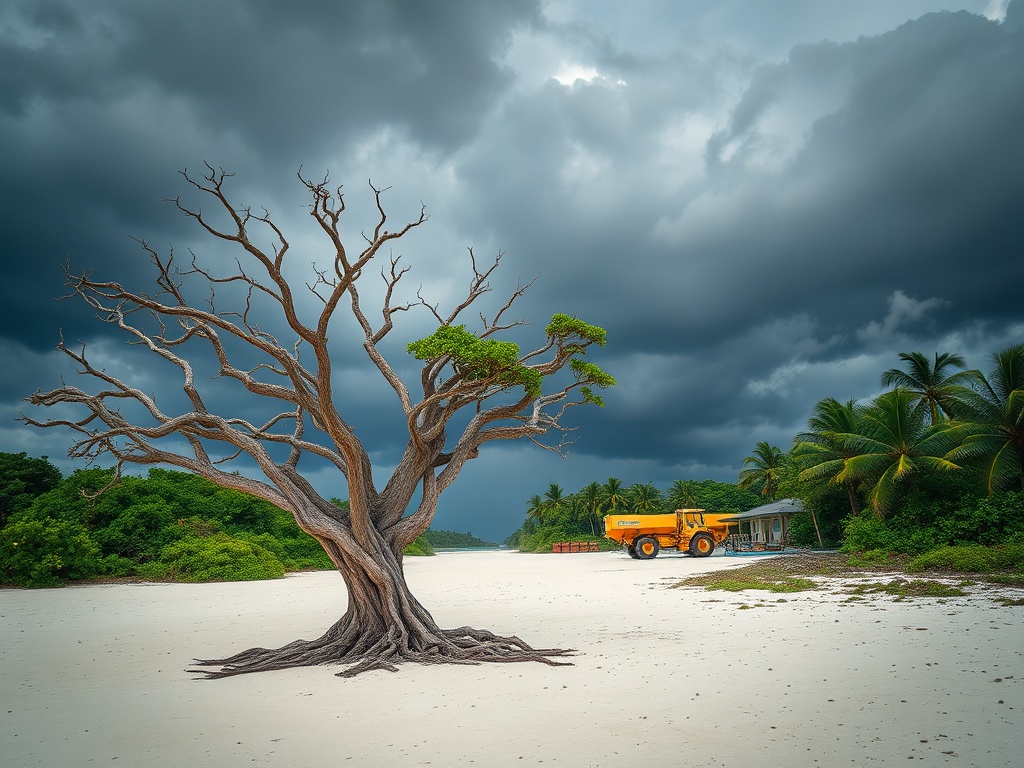
Maldives' Vanishing Defenses: The High Cost of Trading Ancient Trees for Token Gestures
In the fragile geography of the Maldives, a troubling disconnect has emerged between environmental rhetoric and reality. The natural barriers that have protected these islands for centuries—ancient trees with deep roots, coastal vegetation, mangroves, and reefs—are being systematically removed in the name of progress.
This erosion creates dangerous vulnerability in a nation where community existence depends on these ecological safeguards. The irony is stark: while policymakers speak of sustainability, their actions dismantle the very systems that provide it. Removing a ninety-year-old tree, a living monument that has weathered generations of storms, cannot be compensated by planting five hundred saplings that may never mature under current management.
Meanwhile, the theater of environmentalism continues with what critics call 'greenwashing'—transporting plastic bottles in battery-operated vehicles while fundamental extraction systems remain unchanged. This focus on superficial solutions ignores deeper structural problems.
The underlying issue is an economic model that treats the environment as a resource to be extracted rather than a system to be maintained. The same capitalist framework that purports to care about human rights often operates through environmentally destructive practices, creating a walking contradiction.
As weather patterns grow more extreme, the question arises: are these normal fluctuations or precursors to catastrophe? For the Maldives, the answer carries existential weight. Scientific scenarios—rising seas, intensified storms, coral bleaching—threaten not just infrastructure but the islands' very habitability.
The conversation has shifted from whether environmental protection matters to what genuine protection requires. It means recognizing that natural systems being removed represent not obstacles to development but the foundation of survival. The debate now centers on whether decision-makers will acknowledge this reality before protective systems are damaged beyond repair.
— Source fragments: natural barriers, trees, coastal vegetation, mangroves, reefs as protection; removal making vulnerable; superficial green measures like battery vehicles; economic model contradictions; climate change concerns