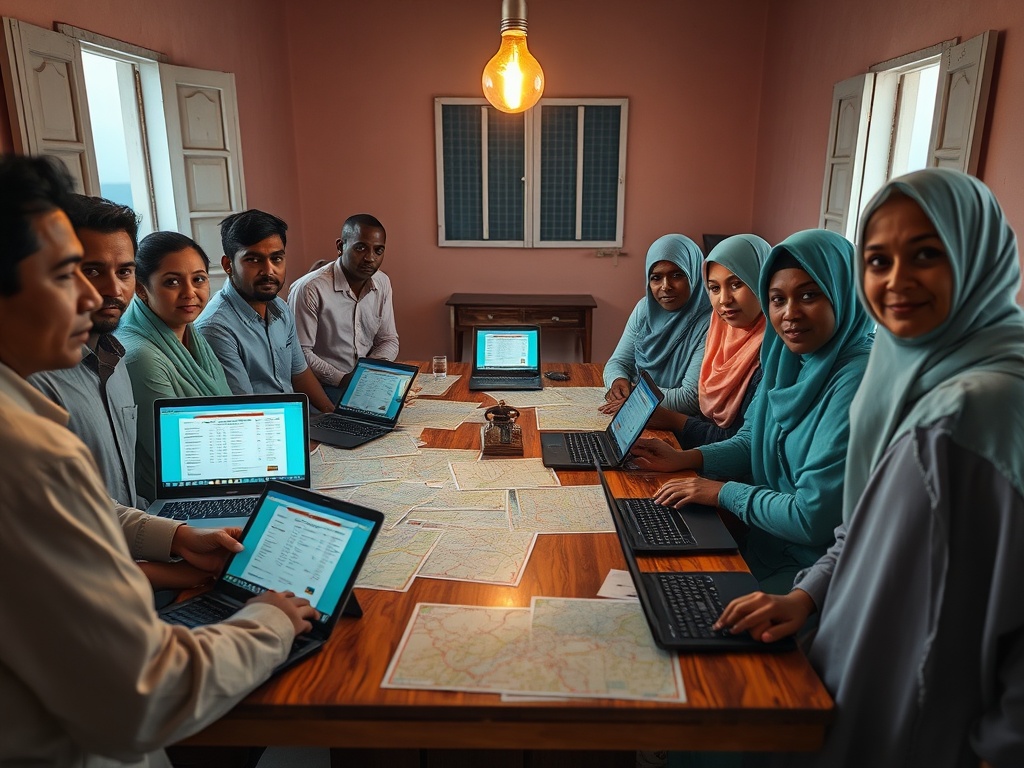
Maldivians Redrawing Their Democracy on Evening Maps
In the corridors of Maldivian political discourse, a quiet revolution is taking shape. It's not unfolding through protests or party manifestos, but in the thoughtful exchanges of citizens examining the very architecture of their democracy. The conversation has moved beyond partisan loyalty to confront systemic questions about how representation works, who gets to vote where, and whether current structures truly serve the nation's needs.
At the heart of this discussion lies the contentious issue of permanent address voting. The current system, where electoral constituency is determined by one's ancestral island rather than current residence, creates significant distortions in political representation. As one observer noted, this creates a peculiar reality where "Majilis would actually be reflecting the reality of the country" if representation matched actual population distribution.
The debate reveals a population increasingly aware of international models. "In countries like U.S, U.K, and most European countries, your electoral constituency is based on your current residential address," one comment noted, highlighting alternative approaches that might better reflect contemporary Maldivian mobility. The massive internal migration to the Greater Malé region has stretched the current system to its limits, with people regularly moving between districts like Galolhu and Henveiru without their voting rights following them.
Technical questions abound in this transition. How would ward boundaries be redrawn? What infrastructure would support address-based voting? And crucially, how long should someone reside in a constituency before gaining voting rights? Some suggest "at least two terms of government" as a reasonable threshold, acknowledging that meaningful connection to a community takes time.
The conversation extends beyond voter registration to the very structure of governance. The idea of a bicameral parliament resurfaces periodically, with proponents arguing that a unicameral system gives "unchecked powers to the MPs." An upper house representing each atoll could provide regional balance, while a lower house based on population would ensure proportional representation.
This reexamination touches on practical administrative divisions as well. Comments suggest that current atoll divisions might need updating, with Vaavu Atoll potentially too small to remain independent. Some propose reducing administrative divisions to 14, updating the historical 13 atolls while potentially reducing parliamentary seats.
The discussion reflects a mature political consciousness—one that recognizes democracy as "a lengthy process" designed precisely to prevent easy manipulation of rules and power. It's a conversation that acknowledges complexity rather than seeking simple solutions, understanding that meaningful reform requires supporting infrastructure and careful implementation.
What emerges from these exchanges is a picture of a polity in transition—moving from passive acceptance of established systems to active engagement with how those systems might better serve a rapidly evolving nation. The questions being raised strike at the foundation of Maldivian democracy, suggesting that the most important political developments may not be happening in the parliament building, but in the thoughtful considerations of ordinary citizens reimagining their governance.
— Source fragments: Permanent address voting debates, constituency based on residential address, bicameral parliament discussion, administrative division reforms, democratic process as lengthy design