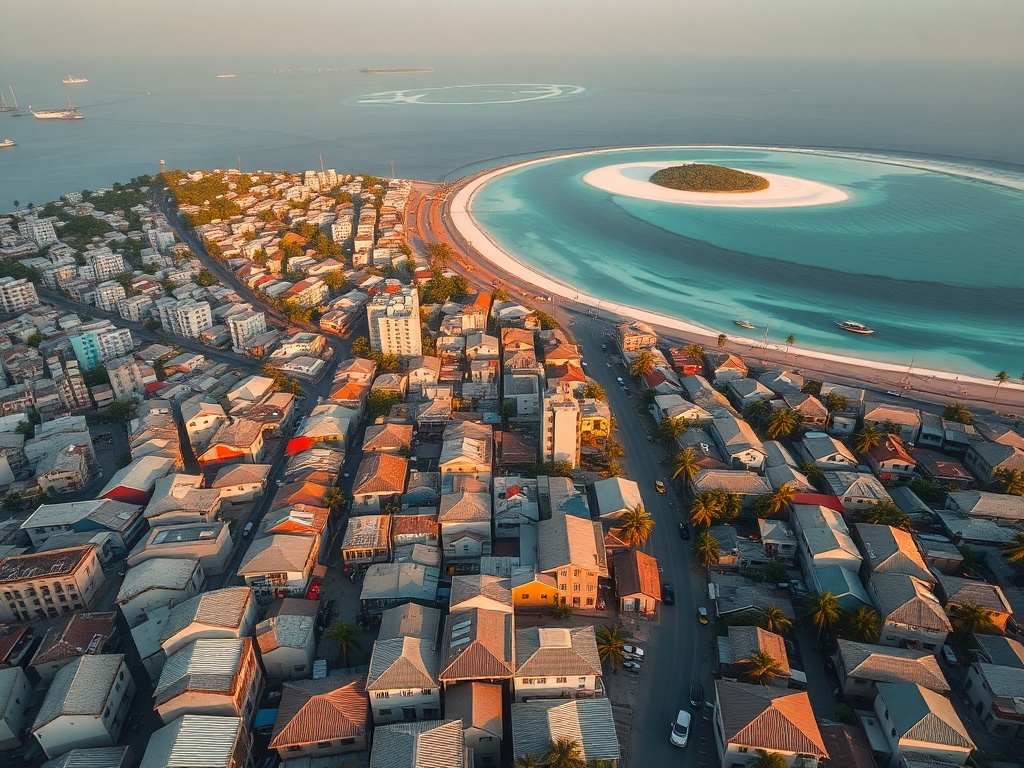
Malé's Crowded Streets and Distant Atolls Fighting Over Land
The debate over who deserves land in the Greater Malé Region has become a mirror reflecting Maldives' most persistent social divide. What appears as a simple policy discussion about housing allocation reveals generations of accumulated resentment, competing claims to national resources, and fundamentally different experiences of citizenship.
At the heart of the controversy lies the tension between Malé as the nation's economic engine and the atolls as its cultural heartland. Critics argue that treating Malé as exceptional—whether through special land rights or exclusion from them—reinforces a supremacy that has historically marginalized outer island communities. The very language of the debate exposes these fractures: the distinction between 'Malé meeha' and 'Raajje therey' carries generations of political and economic baggage.
This isn't merely about real estate. It's about the geography of opportunity in a nation where birthplace often determines destiny. The 'baakee generation'—those caught between islands with no economic future and a capital that treats them as perpetual outsiders—embodies this crisis. They moved to Malé seeking education and employment, only to find themselves excluded from both the communal safety nets of their home islands and the benefits of urban citizenship.
The current land distribution policies have become a flashpoint because they touch upon fundamental questions of fairness. When identical urban residents receive different treatment based on ancestral geography, it reinforces the very discrimination that has fueled regional inequality for decades. The perception that Malé's expansion comes at the expense of atoll communities—that falhus around the capital 'belong to elite Malé'—feeds into broader anxieties about resource distribution.
Yet the solution cannot be simply reversing the discrimination. As one voice notes, 'The Malé person should have the same rights as the RT person.' The problem isn't geographic origin itself, but the system that weaponizes it—the 'thafaathu kurun' or narrow-mindedness that prevents seeing common citizenship beyond regional identity.
What emerges from this heated conversation is not just a policy dispute but a national identity crisis. The trauma referenced by some commentators—the historical marginalization of atoll communities—remains unaddressed in current discussions. Dismissing these lived experiences, as one observer warns, prevents meaningful dialogue about our shared future.
The danger lies in allowing these tensions to harden into permanent divisions. When generations of patience wear thin and conversations descend into accusations of supremacy or racism, we risk losing sight of our common challenges: housing shortages that affect all Maldivians, economic opportunities that should be nationwide, and a national identity that can embrace both Malé's urban reality and the atolls' cultural richness.
The land debate ultimately asks what kind of Maldives we want to build: one where geography determines destiny, or one where every citizen has equal claim to both opportunity and belonging.
— Source fragments: Malé supremacy will ruin rest of Maldives; baakee generation no opportunity in islands or Malé; trauma forced upon raajjetherey meehaa; Malé person should have same rights as RT person; discrimination in land distribution; geographic origin determining rights; historical wealth distribution patterns