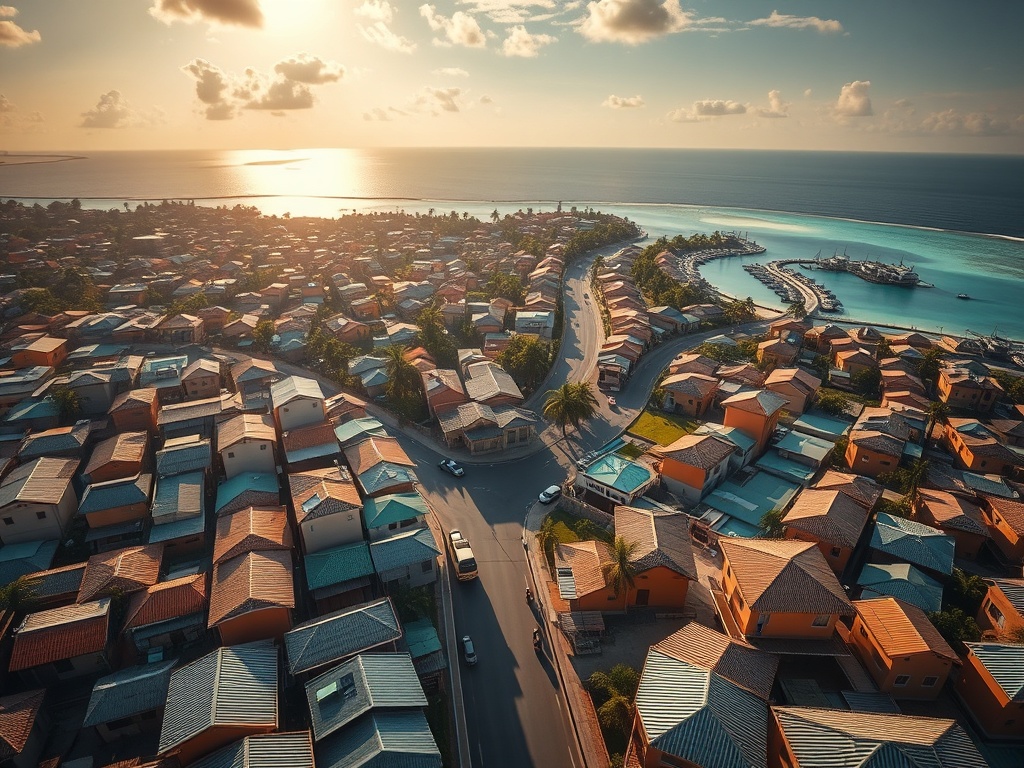
Malé's Impassable Streets and the Search for New Horizons
The debate over Malé's future has reached a critical juncture. The city, long the beating heart of the Maldives, now shows undeniable signs of systemic failure. Streets once navigable by motorcycle have become impassable corridors of congestion, while public spaces vanish beneath concrete. The capital has far exceeded its carrying capacity, and the question is no longer how to fix it, but whether fixing it is even possible.
The symptoms are everywhere. Residents speak of a city where basic mobility has become a daily struggle, where foreign workers navigate narrow streets with driving habits formed in different contexts, adding to the urban chaos. The fundamental issue isn't just traffic—it's a complete breakdown of urban livability. Children lack spaces to play, youth have nowhere to be active, and the elderly find themselves prisoners in their own homes.
Recent development patterns have exacerbated the crisis. Hulhumalé, once envisioned as a solution to Malé's overcrowding, has become what critics describe as a 'concrete jungle' of apartments rather than the balanced urban center it was meant to be. The absence of international-standard convention centers or shopping malls in favor of relentless residential construction reflects a troubling pattern of missed opportunities for creating true community infrastructure.
The solution, many argue, lies not in further congesting the capital region but in deliberate decentralization. The call is for developing Hulhumalé-level cities in the southern, central, and northern atolls—urban centers designed from the ground up with health, sustainability, and community in mind. These would not be mere satellite towns but fully functional cities with their own economic ecosystems, reducing the magnetic pull that has drawn nearly half the nation's population to the greater Malé area.
Some propose specific measures: expatriate villages on industrial islands like Thilafushi to ease housing pressure, prioritizing recreational spaces over parking lots, and fundamentally rethinking urban planning to serve residents rather than developers. The underlying principle is clear: Maldivians must be the priority in Maldivian cities, with foreign workers integrated in ways that benefit rather than burden local communities.
What emerges is a consensus that the era of trying to 'fix' Malé is over. The city represents a planning failure of generational proportions, and the wisest course may be to learn from its mistakes rather than repeat them. The future of Maldivian urban life depends on creating alternatives that offer what Malé cannot: space to breathe, move, and build healthy communities. The capital's greatest legacy may ultimately be the cautionary tale it provides for the new cities that must rise across the archipelago.
— Source fragments: Malé is beyond repair — it has far exceeded its carrying capacity; Solution is to invest in new, healthy urban centres across the country; You can’t even ride a motorcycle in Malé anymore — the city is beyond congested; Hulhumalé has become like concrete jungle; We need more space for children, youth and elderly to move around; All Maldivians must be the priority