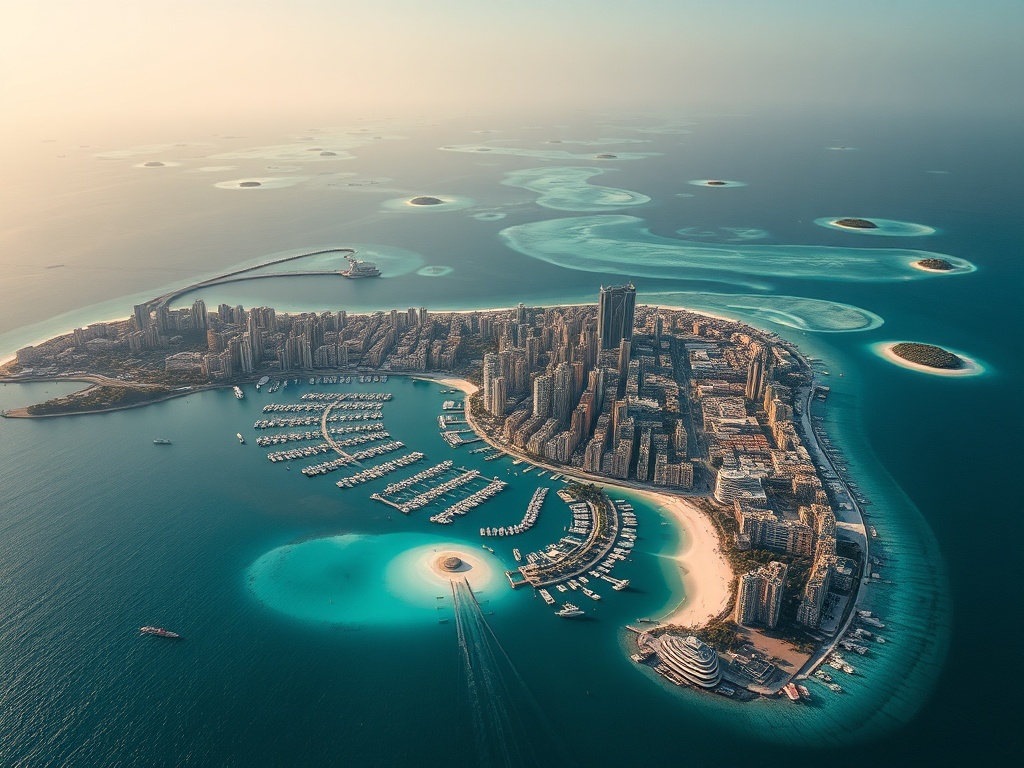
Malé's Skyline or Scattered Island Futures
Across Maldivian social media and public discourse, a fundamental question about the nation's future is taking shape: should the country consolidate its population into supercities, or pursue decentralized regional development? The conversation reveals competing visions for how to achieve progress in an archipelagic nation facing unique geographical challenges.
Proponents of centralization argue that concentrating population in hubs like the Greater Malé area creates economic efficiencies that benefit everyone. "We should centralize atoll populations in bigger islands so that we could increase the affect of that unit of dollars," one perspective emphasizes, suggesting that limited resources should support maximum people. This view sees urban density as the path to advanced infrastructure and services, with Hulhumale' frequently described as "the New York City of Maldives" and the upcoming Rasmalé project cited as evidence that "Male' area has the capacity to grow comfortably for the next 100 years."
The centralization argument extends beyond mere population numbers to encompass a vision of modern urban living. Supporters point to infrastructure like Marine Drive in Malé as "the pinnacle of development," representing not just transportation but a symbolic break from traditional island life. In this worldview, development means embracing contemporary urban aesthetics over nostalgic preservation, with some explicitly rejecting traditional elements like coconut palms as "not fashionable" in favor of more cosmopolitan landscapes.
However, a counter-narrative emphasizes equity and regional balance. Critics argue that "every dollar spent in the islands is better spent as it will help decentralized and achieve equity among the populations." This perspective questions the assumption that centralization automatically benefits everyone, suggesting instead that "the benefit of this privilege is shared by the landlord and the developer" rather than the broader population. The debate has shifted toward regionalization as a middle path—providing scale at the regional level without complete concentration in Malé.
The tension reflects deeper questions about development philosophy. While centralized models promise efficiency and modernity, regional approaches emphasize equitable distribution of resources and preserving community networks across the archipelago. Both sides agree that current patterns are unsustainable—with warnings that "without localized centralization the atolls will eventually become empty"—but differ fundamentally on solutions.
As the Maldives continues its rapid development trajectory, this conversation represents more than just urban planning preferences. It touches on core questions of national identity, economic justice, and what constitutes meaningful progress for a nation scattered across hundreds of islands. The resolution will likely shape not just population distribution but the very character of Maldivian society for generations to come.
— Source fragments: Centralization arguments: 'supercity to house 2 million ppl', 'Hulhumale' is the new york city', 'centralize atoll populations', 'Male' area has capacity to grow for next 100 years'. Decentralization arguments: 'benefit shared by landlord and developer', 'dollars spent in islands better for equity', 'government should focus on regionalization'. Development aesthetics: 'road on coast is pinnacle of development', 'coconut palms not fashionable'.