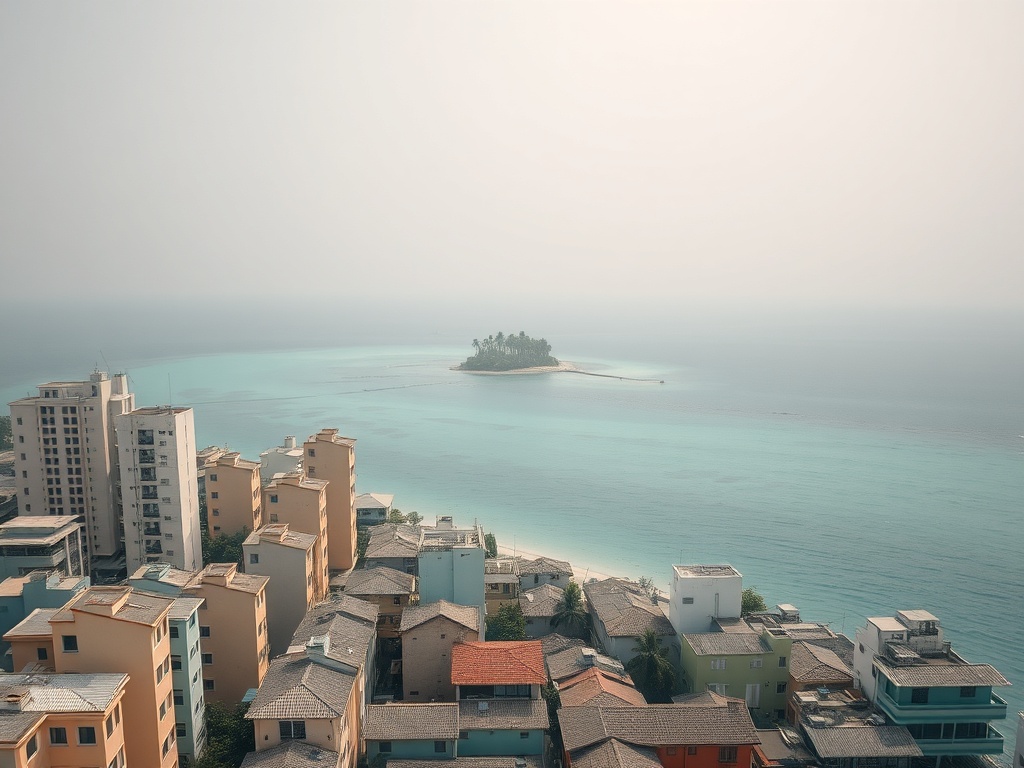
Malé's Skyline Rises as Outer Islands Wait for Water
In the scattered archipelago of the Maldives, a persistent tension defines national development: the gravitational pull of the capital versus the scattered potential of the outer atolls. For decades, the narrative of progress has been written in the concrete and rebar of Malé, its skyline a testament to concentrated ambition. Yet, this very concentration now breeds a palpable sense of stagnation and frustration among citizens who see the rest of the nation languishing.
The critique is not merely about geography but about vision. The call for developing "population hotspots" in the north and south is more than a demand for equity; it is a strategic imperative. Funneling vast sums into repetitive housing blocks in the capital, while other islands lack basic industrial or economic scaffolding, creates a nation of dependencies rather than a network of self-sustaining communities. The result is a congested capital, described by some as a 'dustbin,' buckling under the weight of its own inefficiencies, from traffic gridlocks that choke economic activity to infrastructure that fails at a fundamental level.
This infrastructural decay is not abstract. It manifests in the mundane yet critical details: insulation so poor that cooling systems work overtime, achieving little while consuming vast amounts of power. It is seen in projects discussed for over a decade, where initial estimates balloon and execution is perpetually 'half-arsed.' The pattern suggests a systemic failure in planning and procurement, where grand announcements are rarely matched by competent delivery. The consequence is a devastating drain on the economy, where a single week of roadblocks in the capital can strangle millions in daily transactions.
The underlying issue transcends any single administration and points to a deeper governance malaise. When councils and authorities become synonymous with incompetence and delay, public trust erodes. The focus shifts from long-term nation-building to short-term political posturing, leaving critical national needs—reliable power, efficient transport, diversified industry—in a perpetual state of neglect. The real patriotism, it seems, lies not in symbolic gestures that paralyze the capital, but in the unglamorous, disciplined work of building a resilient and balanced nation where opportunity is not a privilege of the center but a right for all.
— Source fragments: I agree, developing islands have been neglected for far too long... Instead of funnelling all money to housing, develop industries in south and north; insulation leaks will never make 15 degree achievable so compressor will be just wasting power; Male is a dustbin now; How many years have we been spending on narudhamaa and power plants. Doing nothing!; Can we do anything right in the country? Always half arsed at the sky high price; This is totally waste, useless and devastating to the economy of Male city... Congesting the traffic with road blocks for an entire week..This is not Patriotism..It is madness..