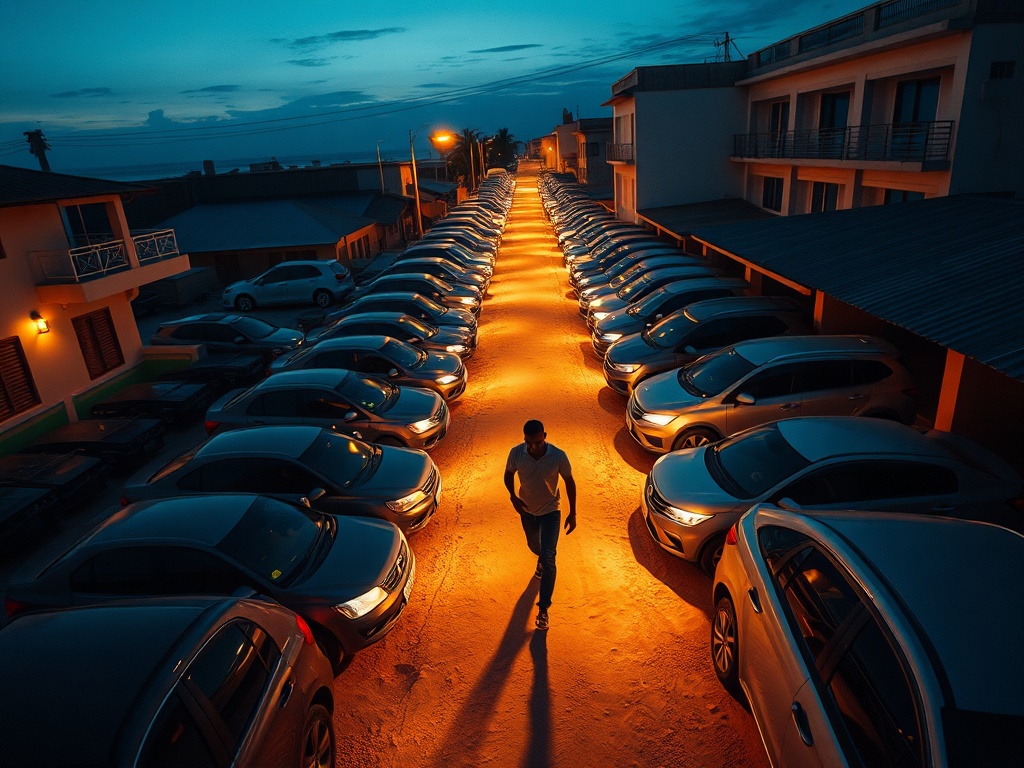
Metal Ghosts Choke Hulhumalé's Streets
The story of modern Maldives is often told through the lens of its waters—the turquoise lagoons, the rising seas, the coral reefs. But on the ground, in the cramped atolls that constitute its urban centers, a different, more metallic story unfolds. It is written in the gleaming bodies of cars, vans, and motorcycles that now choke the narrow streets, a story of aspiration, necessity, and a collective failure of planning.
In Hulhumalé, the once-spacious, purpose-built extension of the capital, a surgical operation is underway. Authorities are targeting the carcasses of progress—unlawfully parked, unregistered, and damaged vehicles. These metal ghosts, left to rust in public spaces, are symptomatic of a system overwhelmed. The promise of temporary parking for registered vehicles from Greater Malé is a band-aid on a hemorrhaging wound. It acknowledges the problem but cannot solve the fundamental equation: limited land plus unlimited desire for mobility equals gridlock.
Car ownership here is less a passion and more a pragmatic, often painful, response to circumstance. The family sedan is a mobile sanctuary in a city where personal space is a luxury. The taxi is a lifeline in an urban fabric where walking distances are compressed but made arduous by congestion and climate. For the judge, the businessperson, the parent, the vehicle is not a symbol of freedom but a costly, indispensable tool for navigating a fractured daily life. The idea of limiting registrations per person surfaces as a logical, if administratively fantastical, solution—a testament to the desperation felt by residents who watch their shared space evaporate under sun-bleached sheet metal.
The vehicle crisis mirrors the broader Maldivian paradox. It is a physical manifestation of the migration patterns squeezing the life out of the capital, of the socioeconomic environment that makes alternatives seem impossible, and of a governance structure that struggles to enforce a holistic, long-term vision.
Looking at Malé reveals the truth. The vehicles are more than transport; they are pressure valves for a system under strain. They represent the individual's attempt to solve a collective problem, resulting in a collective nightmare. Each shiny hood is part of an intricate, unsustainable ecosystem. The cleanup in Hulhumalé is a start, but the real renovation required is not of parking lots, but of the very mindset that allows a nation's dreams to be paved over, one parking space at a time.
— Source fragments: User voices on vehicle population limits, enforcement difficulty, car ownership as necessity (family/taxis), Hulhumalé vehicle removal initiative, observations of urban change in Malé/Hulhumalé, and the lack of holistic urban planning.