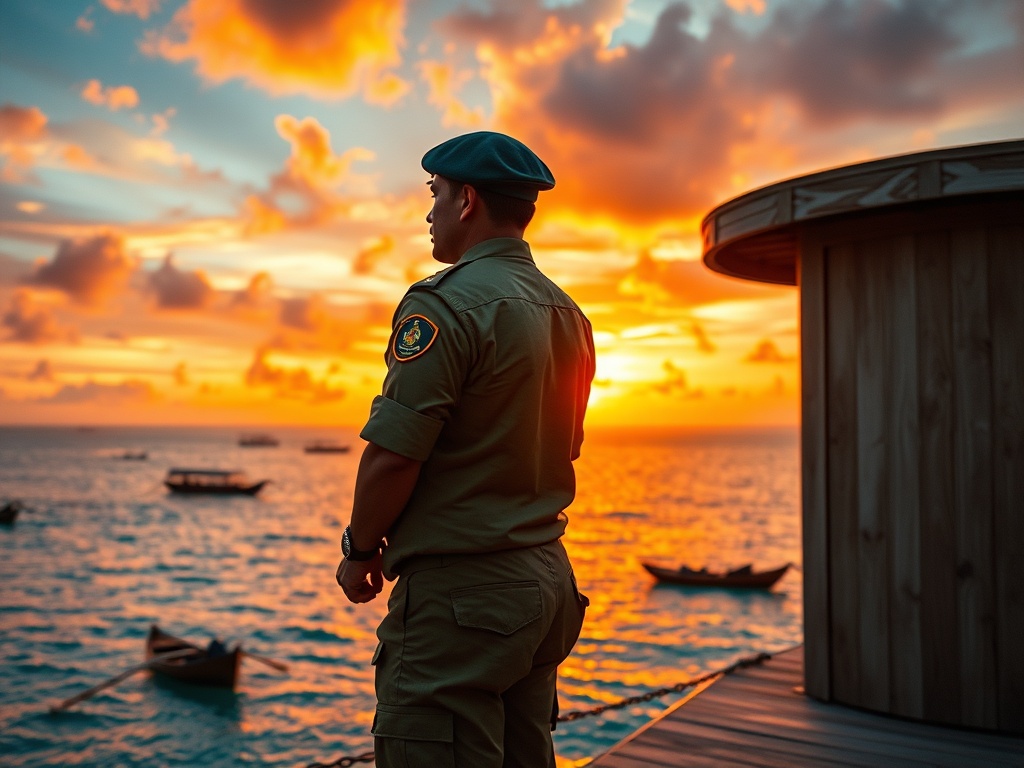
Military Budgets Rise as Fishermen Watch from Their Dhonis
In the scattered atolls of the Maldives, a serious conversation about national defense is unfolding—one that pits historical reliance against emerging sovereignty concerns. The debate centers on whether a small island nation should invest more heavily in its military capabilities, not for outright conflict, but for strategic positioning in a complex regional landscape.
The argument draws parallels with Singapore, another small nation that maintains substantial defense spending despite its size. Proponents point to Singapore's 'security paranoia' as a model worth emulating—a nation that could theoretically rely on American protection but chooses instead to build its own deterrent capacity. This perspective suggests that sovereignty isn't just about independence in peacetime, but about negotiating strength during diplomatic tensions.
Critics counter with examples like Iceland, which maintains zero military expenditure while ranking among the world's safest countries. They question whether missile systems and advanced hardware serve any practical purpose for an archipelago nation where the primary security threats may be non-traditional: drug trafficking, maritime domain awareness, and climate-related disasters.
The discussion reveals nuanced positions. Few advocate for turning the Maldives into an armed camp—the Swiss model of responsible, trained citizen ownership is referenced as a potential middle ground. The conversation acknowledges that when foreign forces have historically intervened, Maldivian defense personnel were already taking control of situations, with external partners providing supplementary support.
Recent government investments in rehabilitating MNDF and police facilities suggest this debate has already influenced policy. The underlying question remains whether military spending represents genuine security enhancement or symbolic politics. In a nation where economic pressures mount daily—from currency shortages to housing crises—every rufiyaa allocated to defense must be weighed against pressing social needs.
What emerges is a sophisticated public understanding that defense strategy extends beyond weaponry. It encompasses surveillance capabilities, training standards, and the delicate balance between self-reliance and international partnership. As one observer noted, it's not about preparing for war, but about ensuring that when negotiations occur, the Maldives approaches the table from a position of strength rather than dependency.
The conversation reflects a nation maturing in its geopolitical awareness, recognizing that in the Indian Ocean's strategic waters, sovereignty is both a principle and a practice—one that requires constant recalibration between ambition and reality.
— Source fragments: Comparisons to Singapore's defense spending, arguments about sovereignty and negotiating position with India, discussion of Iceland's zero military budget, debate about purpose of missiles versus surveillance drones, references to historical Indian military presence and MNDF capabilities