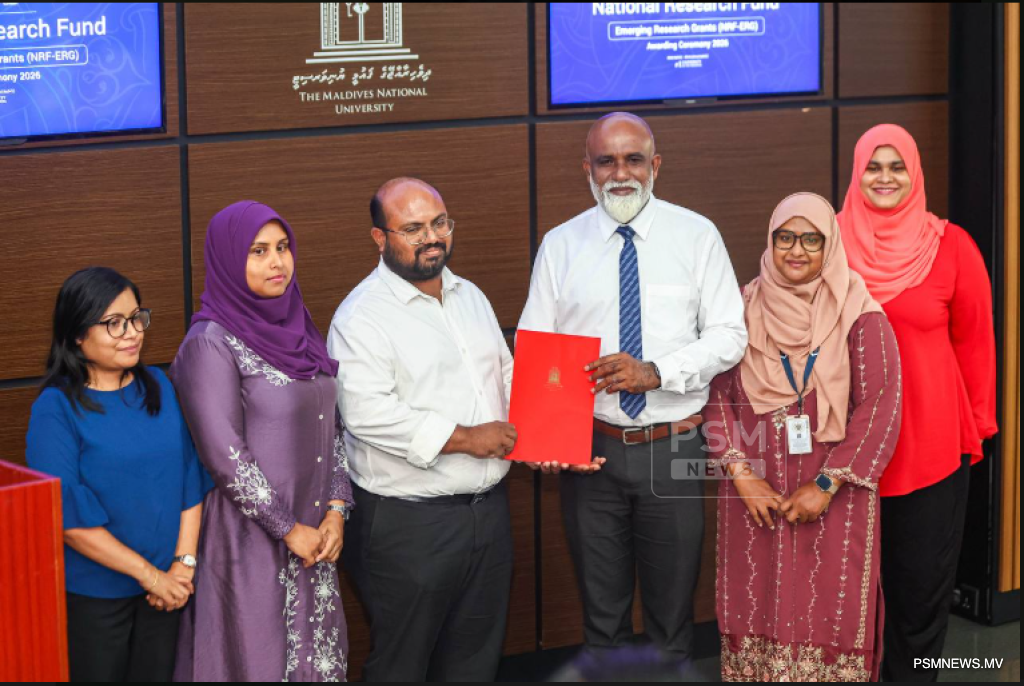
MNU Awards 11 Research Grants to Tackle National Challenges Using AI and Law
The Maldives National University (MNU) has awarded funding to 11 emerging research projects designed to provide evidence-based solutions for critical national issues. The grants, distributed under the National Research Fund: Emerging Research Grants (NRF-ERG) Call 1, cover diverse fields including artificial intelligence, healthcare, cybersecurity, and cultural preservation.
Minister of State for Education, Higher Education and Skills Development, Ahmed Shafeeu, presented the grants during a formal ceremony. Launched in 2025 and supported by the National Research Council, the NRF-ERG programme aims to elevate the quality of academic research within the Maldives while addressing practical societal hurdles.
MNU reported a surge in interest from university researchers, leading to a highly competitive selection process. While 16 proposals were initially deemed meritorious, a total funding cap of USD 97,024.58 necessitated a second round of rigorous ranking. Ultimately, the 11 highest-scoring projects were selected to utilize the full allocation.
Technological innovation is a cornerstone of this cycle's awards. Key projects include an edge-AI system for automated drowning detection and harbor security (AEGIS-M), and an AI-driven approach to enhance agricultural productivity through smart farming. The university is also funding the development of a Dhivehi Reference Manager to integrate parallel English styles into digital workflows.
Social and legal reforms are also highlighted, with funded research focusing on gender equality and access to justice within Maldivian family law, as well as an analysis of public perception regarding the integrity of the Maldives Police Service. In healthcare, the university is backing studies on the implementation of the generational tobacco ban and tuberculosis screening practices among the working-age population in the Greater Malé area.
Further projects will address cyber resilience in the financial sector, household electricity consumption for cooling in Malé, and the urgent digitizing of Maldivian folklore to ensure cultural preservation.
Through these initiatives, MNU seeks to strengthen its research capacity and foster a culture of innovation. By bridging the gap between academic inquiry and national development, the university aims to reinforce its position as a leading institution providing the data necessary for informed policy-making in the Maldives.