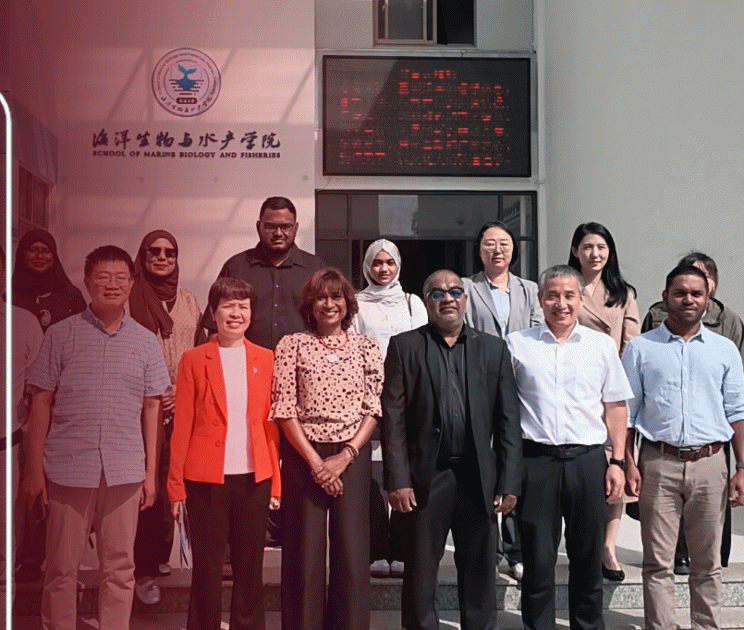
MNU delegation returns from Hainan with plans to reshape Maldives marine science and fisheries training
A delegation from the Maldives National University (MNU) has returned from a visit to Hainan, China, describing the trip as an important step in strengthening the Maldives' approach to marine science research, fisheries education and training future marine scientists.
The delegation, made up of lecturers from MNU's College of Fisheries and Ocean Science along with students and university officials, travelled to Hainan from the 10th to the 14th of this month and visited Hainan University, one of China's most advanced institutions in marine life and fisheries research.
During the visit, the delegation obtained information on world-class environmental research laboratories, rapidly operating aquaculture facilities, programmes for restoring coral reefs, and educational systems that directly connect students to the fisheries industry.
Han Jia, Director of the Division of International Economic Cooperation of the Foreign Affairs Office of Hainan Province, noted the similarities between the two tropical island regions, saying both have strong fisheries and agriculture sectors and economies based mainly on a healthy ocean environment.
"Hainan Province and the Maldives are located in the tropical region. And our climate and environment are very similar. In addition, there is also a very great similarity between the two places as destinations for fisheries and agriculture, as well as international tourism," he said.
"In the future, the two sides can work together in a wide range of areas in education, tourism, as well as modern technology."
The Dean of MNU's College of Fisheries and Ocean Science, Ahmed Riyaz Jauhary, said the trip broadened the students' thinking and opened their eyes, giving them the opportunity to see in practice the latest projects at Hainan's most modern research centres, especially work on aquaculture and coral reef restoration.
He described the gap in research capacity as a great opportunity for the Maldives.
"Their scientific advancements are currently ahead of ours.... but it is certain that through such trips and the relationships enriched by them, the way will be paved to take the Maldives' research environment to new heights."
One of the most practical outcomes of the trip is an educational model submitted to the Maldives by Hainan University. The Dean of the university's School of Marine Biology and Fisheries, Professor Xie Songguang, detailed the "Science and Technology Backyard" principle that the university has been successfully using.
It is a system in which the university's units are established directly within fisheries companies, and students and lecturers go out into the practical field of the industry and seek scientific solutions to real problems directly facing the industry.
"Working in this way, solutions can be found directly for the technical challenges facing the fisheries industry. And at the same time, students are trained with practical industry experience, and after learning, gain the ability to serve the industry in the most complete way in the field of employment," Professor Xie said.
He noted the model is currently being successfully implemented in Namibia and Indonesia as well, and said Hainan University would give its full support to bring the model to the Maldives.
The delegation also visited Sanya's West Island, where particular interest was created among the Maldivian delegation in a model of delivering marine science education linked to a broad tourism business.
The trip also highlighted the importance of educational diplomacy, with the relationship between the Maldives and China described as not merely one of infrastructure development and trade.