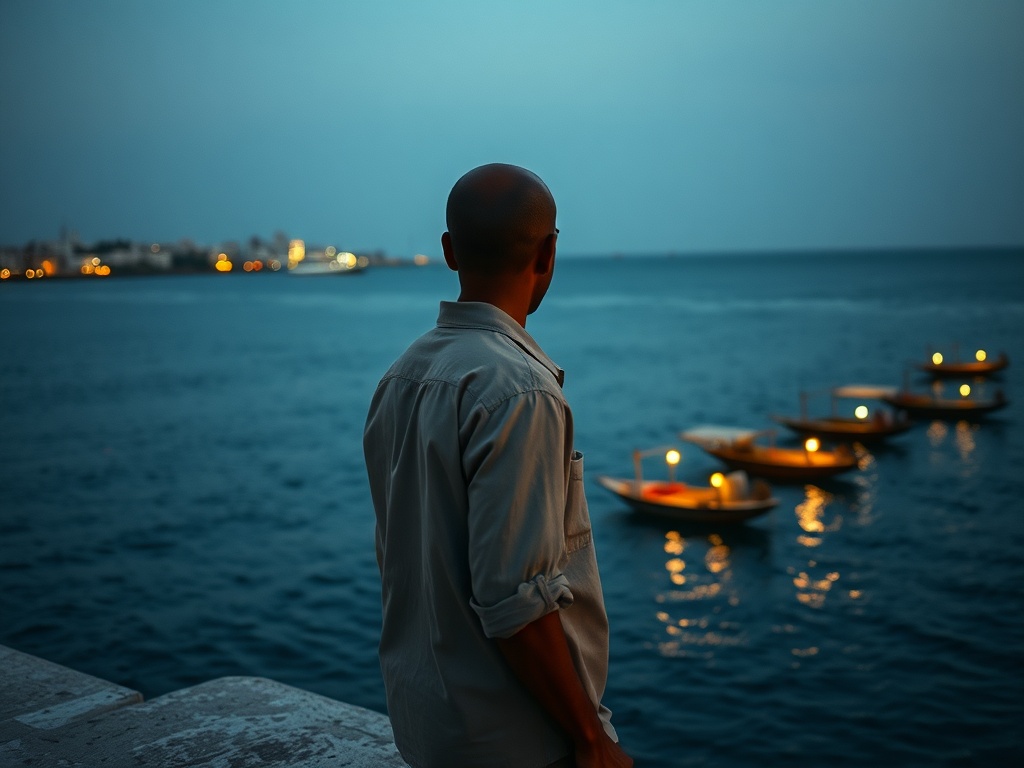
Monsoon Clouds Gathering Over Malé Harbor
The sea has a way of holding everything—the weight of our hopes, the salt of our disappointments, the slow erosion of what we thought was permanent. These days, when I walk along the harbor wall in Malé, I feel the pressure building like the monsoon clouds gathering on the horizon. Not in dramatic storms, but in the quiet accumulation of small tensions—the way a fisherman feels the subtle shift in current long before the waves change.
We live in a nation suspended between sea and sky, where the distance between paradise and struggle is measured in breaths. The air smells of salt and diesel, of frying garudhiya and exhaust fumes. In the narrow streets between concrete buildings, you can hear the echoes of conversations about jobs that never materialize, about prices that climb faster than wages, about dreams deferred until they become memories of what might have been.
There's a particular heaviness to life here that tourists never see—the weight of being both isolated and overcrowded, of having everything and nothing at once. Our islands float in jewel-toned waters, but our youth float in uncertainty. Our economy depends on visitors who see only the surface beauty, while beneath the waves we navigate currents of dependency and scarcity.
The political arguments that rage on television and social media feel distant when you're standing in line for bread, when you're calculating how to stretch this month's salary until the next. Yet they're present in the way your neighbor avoids your eyes when certain topics arise, in the careful language we use in public spaces, in the unspoken understanding that some truths are better left submerged.
Still, the rhythm of the islands continues—the call to prayer, the fishermen returning at dusk, the children playing on the seawall as their parents did before them. There's resilience in these daily rituals, in the way we've learned to find stability in uncertainty, to build lives in the spaces between the political and the personal. The sea teaches patience—the same waves that erode the shoreline also bring new treasures with each tide. Perhaps we're learning that our strength isn't in resisting the currents, but in learning to navigate them.
— Source fragments: High cost of living, Youth issues: unemployment, Housing crisis in congested capital, Eroding freedom of expression, Heavy import reliance, Tourism as main forex source but limited national benefit