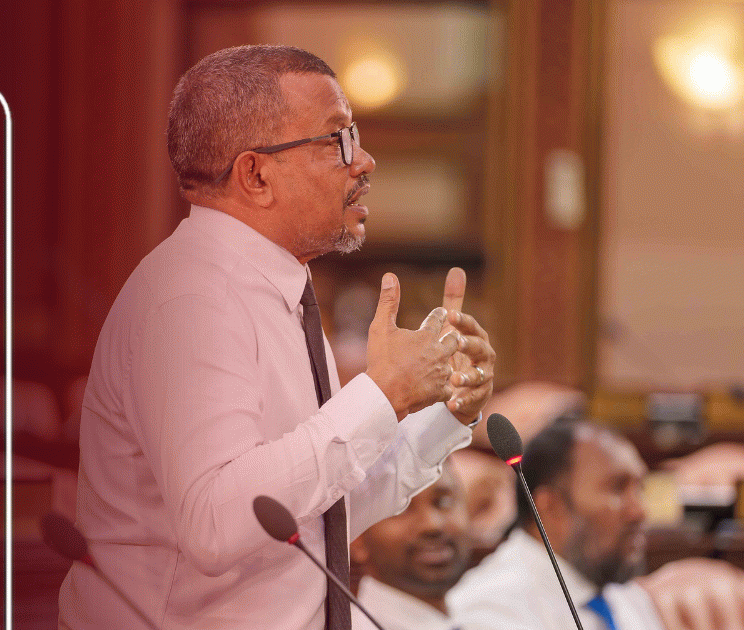
MP Kudu Raises Fear of People Being Framed and Sentenced Once Death Penalty Law Takes Effect
Galolhu North constituency MP Mohamed Ibrahim (Kudu) said today that he is concerned that, from the point the bill on the enforcement of the death penalty becomes law, people could be framed and taken to the point of being sentenced to death.
Speaking in the debate on the bill submitted by Gulhi constituency MP Hanan Mohamed Rashid on the part of the ruling PNC, Kudu said that from the building of mosques to mosque buildings, up to the Hajj quota, there is manipulation. Therefore, Kudu said it is a fact that everyone knows that "even in buying sand for construction, there will be corruption."
"Unless a very just trial is conducted, a person's life cannot be taken. It is a fact that none of us will dispute that there are major problems in the Maldives' criminal justice system. My concern is whether, once this bill becomes law, people will be framed and taken to the point of killing a person," Kudu said.
The bill states that if a lower court rules that the convict be put to death as punishment for the offence, a higher court must examine all the legal points of that ruling and the manner in which the case proceeded.
The bill states that the death penalty must be determined by an independent and impartial court established by law, after a trial conducted openly in a public hearing held within an adequate period. It makes it obligatory to examine, before the Supreme Court determines the death penalty on the convict, the manner in which the trial was conducted.
The bill also states that the convict shall be able to obtain the assistance of a legal counsel.
Under the bill, the death penalty can only be determined if all the heirs of the murdered person agree to it in court.
In addition, the bill sets out the circumstances in which the enforcement of the death penalty may be postponed. Among them: if the convict becomes ill, if she is heavily pregnant, until two years of the child's age, or until the court determines a course after the convict submits a request for a review of the sentence, or until a case is submitted to the Supreme Court in connection with the postponement of the enforcement of the death sentence, or if the convict's mental and physical health is below an adequate level, the enforcement of the death sentence may be postponed until recovery.
Under the bill, the death penalty can be enforced by hanging.
Likewise, the bill prohibits enforcing the death penalty in a place where the scene of the enforcement of the death penalty on the convict would be publicly visible. And recording the scene and sound of the enforcement of the death penalty in any form and making it public is also prohibited.
The bill states that a panel must be assembled for the enforcement of the death penalty. The seven-member panel includes a corrections officer appointed by the Commissioner of Prisons, a police officer appointed by the Commissioner of Police, a prosecutor appointed by the Prosecutor General, a member determined by the Majlis, a doctor determined by the Medical and Dental Council, a person determined by the Supreme Court, and a religious scholar determined by the Fatwa Majlis.
The bill states that within 72 hours of the enforcement of the death penalty, the convict, his family, legal counsel, corrections and the heirs of the murdered person must be informed.