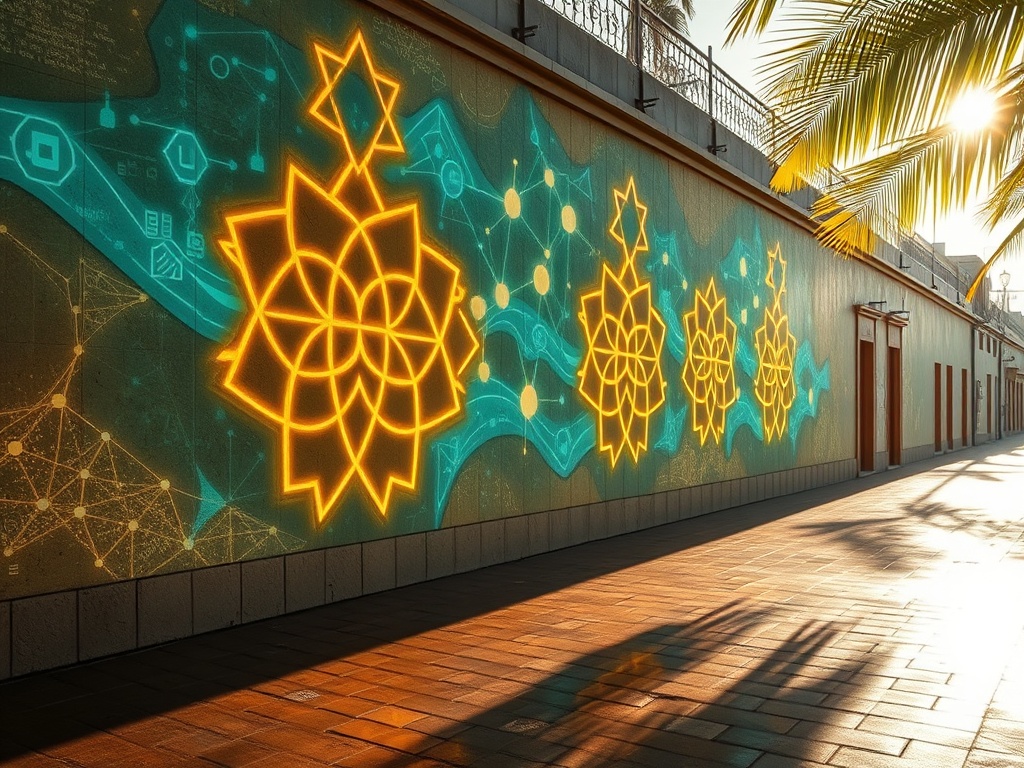
Muslims Avoiding the Internet Built on Islamic Math
In the digital age's constant hum of online discourse, a curious contradiction recently surfaced: the suggestion that Muslims should avoid the internet, while the very architecture of our digital world owes its foundation to Islamic scholars. The irony isn't merely academic—it cuts to the heart of how modern Muslim communities navigate technology, tradition, and identity.
The observation points to Muhammad ibn Musa al-Khwarizmi, the 9th-century Persian mathematician whose work formed the basis of algebra and algorithms. His name, latinized as "Algoritmi," literally gives us the word "algorithm" that powers everything from social media feeds to financial systems. This historical truth stands in stark contrast to contemporary debates about technology's place in Muslim life.
Across Muslim societies, including majority-Muslim nations like the Maldives, this tension manifests in daily life. Younger generations embrace digital tools for education, business, and social connection, while some religious conservatives view the internet with suspicion—fearing cultural dilution, moral corruption, or the erosion of traditional values. Yet this binary overlooks Islam's rich history of scientific and mathematical innovation during the Golden Age, when Muslim scholars preserved and advanced knowledge that would later fuel the European Renaissance and ultimately the digital revolution.
The modern dilemma isn't about rejecting technology wholesale, but about developing a coherent framework for its use. How does a 100% Muslim nation like the Maldives harness digital tools for economic development while maintaining religious and cultural integrity? The answer lies not in avoidance, but in conscious engagement—recognizing that the same intellectual tradition that produced al-Khwarizmi's mathematical breakthroughs can guide ethical technology adoption today.
This isn't merely historical trivia; it's a living conversation about ownership. When Muslims use technology, they're not adopting foreign innovation but reconnecting with their intellectual heritage. The algorithms that power our phones, the mathematical models that run our economies—these are descendants of Islamic scholarship. The challenge, then, is not whether to use technology, but how to shape it in ways that reflect Islamic values and serve Muslim communities.
As digital platforms become increasingly central to political discourse, education, and commerce, this conversation grows more urgent. The real irony isn't just historical—it's that by rejecting technology, some risk abandoning the very intellectual tradition that made modern computation possible. The path forward requires neither blind acceptance nor fearful rejection, but thoughtful integration that honors both faith and progress.
— Source fragments: Funny how she says Muslims shouldn't use the internet when the very 'algorithm' running this site was inspired by a Persian Muslim mathematician, Al-Khwarizmi. The irony writes itself!