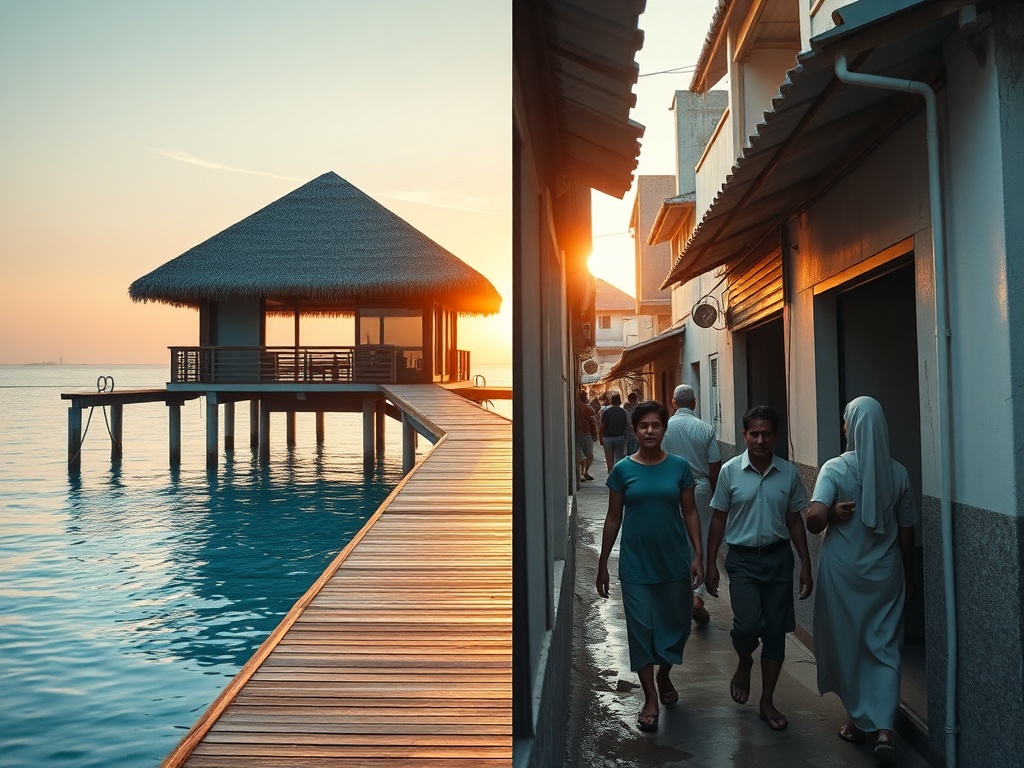
Nepobaby Class Thrives as Maldives' Tourism Billions Bypass the Masses
From the deck of a dhoni on turquoise waters, the Maldives presents a postcard-perfect vision of success. Gleaming resorts dot the horizon, symbols of an industry generating billions. Yet, on Malé's crowded streets and outer atolls, a different reality simmers—one of economic strain, frustrated aspirations, and a sense that national wealth lifts only select yachts.
This is modern Maldivian prosperity's core contradiction. Official figures tout tourism generating over $5 billion annually, a sum that should buffer against debt and fund public services. But the math doesn't add up for citizens. External debt stands at $3.4 billion, a weight incongruous with incoming revenue. The disconnect lies in destination: significant tourism profits are parked abroad by resort owners, causing foreign currency shortages that strangle import-dependent businesses and drive up living costs.
The promise of decentralized benefits through the 'guest house model' has proven a smokescreen for many. While islands like Maafushi show development, this model often replicates the central flaw: success requires pre-existing land, political connections, and capital. For most islanders without these, economic spillover remains a mirage. The result is a two-tiered system where a connected elite captures tourism value, while the broader population faces inflation and scarcity.
This economic concentration is reinforced by political patronage. The state's role has shifted from regulator to competitor and favor distributor. Government-owned enterprises, from airlines to housing ventures, are seen as market distorters that crowd out private initiative. Subsidizing services like public transport offers temporary relief but risks eroding private sector sustainability, creating dependency. Distributing subsidized housing and assets as electoral currency politicizes basic economic rights, turning necessities into tokens of political loyalty.
Consequences include a stifled private sector and a populace looking vertically to the state, not horizontally for opportunities. Citizens speak of a 'nepobaby class' living off state largesse and protected monopolies, while fishermen see undervalued catches and youth face limited job prospects beyond political appointments. The call is for fundamental recalibration—investment in atoll economies for real jobs, state policy fostering competitive markets, and harnessing earnings to build sovereign assets and repay debt, not private fortunes.
The sentiment demands systemic integrity. A nation cannot build lasting wealth by continuously leasing core assets to foreign interests while sidelining capable citizens. The path requires moving beyond aggregate figures to confront distribution. Maldives' prosperity is hollow not in generation, but in circulation. Until that cycle breaks, the gap between earnings and welfare remains the defining economic failure.
— Source fragments: Stopped buying... due to price gouging... over taxing; Maafushi model is an extension of the exploitative and discriminatory business model; guest house nonsense... a smoke screen... benefit was limited to a few; Our external foreign debt is 3.4 billion and we earn 5.4 billion; Why do some among us always seek to hand over state assets to foreign nationals?; These are monopoly businesses so the price is set not by competition; too many wealthy people are living off at our expense. esp the nepobaby class; When it becomes a burden on gov & cannot continue, there will be no one left to give the service; People are too much dependent on govt for everything.