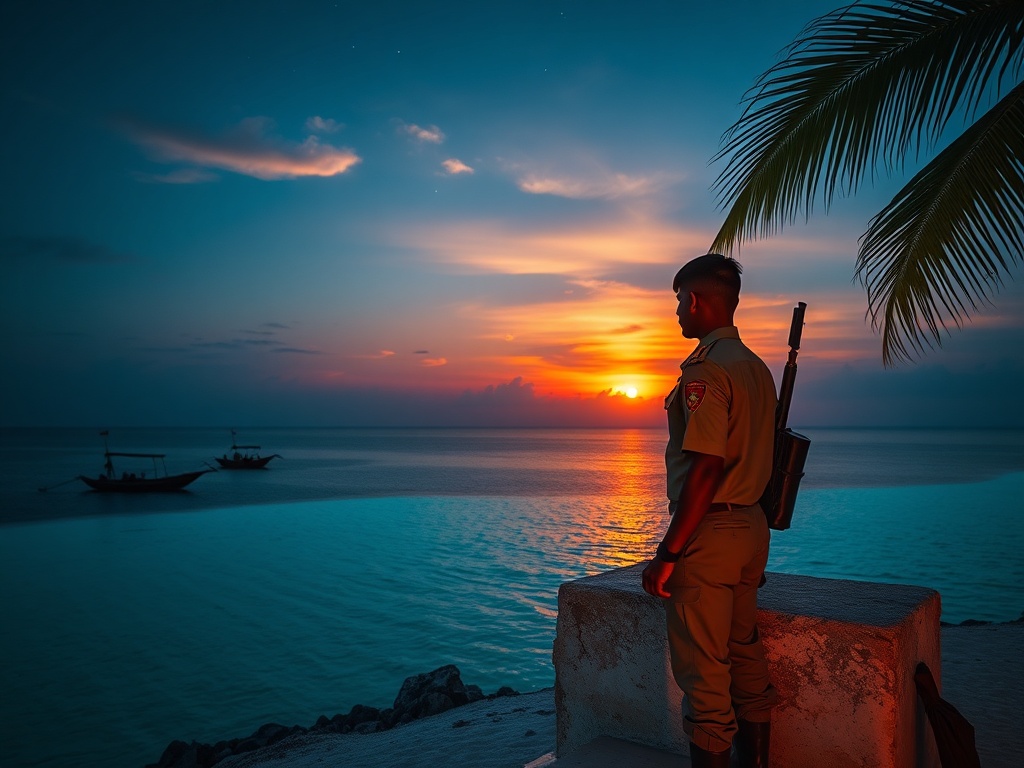
One Soldier Watching the Horizon at Dusk
The ocean teaches us about depth and surface, about what lies beneath and what remains visible. In these scattered thoughts about sovereignty and security, I hear the echoes of a deeper conversation about what it means to be small in a world of giants.
Like Singapore, another island nation that understands the precariousness of geography, we navigate the same currents of self-preservation. Their investment in defense isn't mere paranoia—it's the recognition that sovereignty isn't given but maintained. The sea around us doesn't care about our size; it simply is. And like the ocean, geopolitics has its own relentless tides.
I remember the November 3rd incident that surfaces in these conversations—that moment when foreign forces overstayed their welcome, when our defense forces stood shell-shocked. These memories linger in our collective consciousness like the scent of salt after rain. They remind us that defense isn't about anticipating war, but about maintaining dignity. It's the difference between hosting guests and being occupied.
The rehabilitation of MNDF facilities mentioned in one fragment speaks to this ongoing work—not of preparation for conflict, but of building capacity. Like the coral reefs that protect our shores from the ocean's fury, a trained, responsible defense force becomes the living barrier between sovereignty and subjugation.
Yet there's wisdom in recognizing limits. 'Maybe we won't need to go that far,' one voice suggests, acknowledging that posturing has its place, but excess has its costs. The Swiss example surfaces—a nation where responsible ownership doesn't mean chaos, where preparedness and responsibility coexist.
What emerges from these fragments isn't a call to arms, but a meditation on balance. The same way we read the ocean's moods by watching the waves, the color of the water, the behavior of birds, we must read the geopolitical currents. Investment in defense becomes not about threatening others, but about ensuring our voice carries weight in negotiations, that our 'no' means no, that our hospitality remains a choice rather than a necessity.
The final fragment about using MNDF to 'clean the city' resonates metaphorically—perhaps what we truly seek is not military might, but the capacity to maintain order, to preserve what makes us who we are. In these scattered thoughts, I hear not fear, but the quiet determination of people who understand that even the smallest island can weather the largest storm when it stands firm in its own waters.
— Source fragments: Singapore comparison, sovereignty concerns, historical reference to foreign forces overstaying, defense facility rehabilitation, Swiss gun ownership analogy, MNDF civic role suggestion