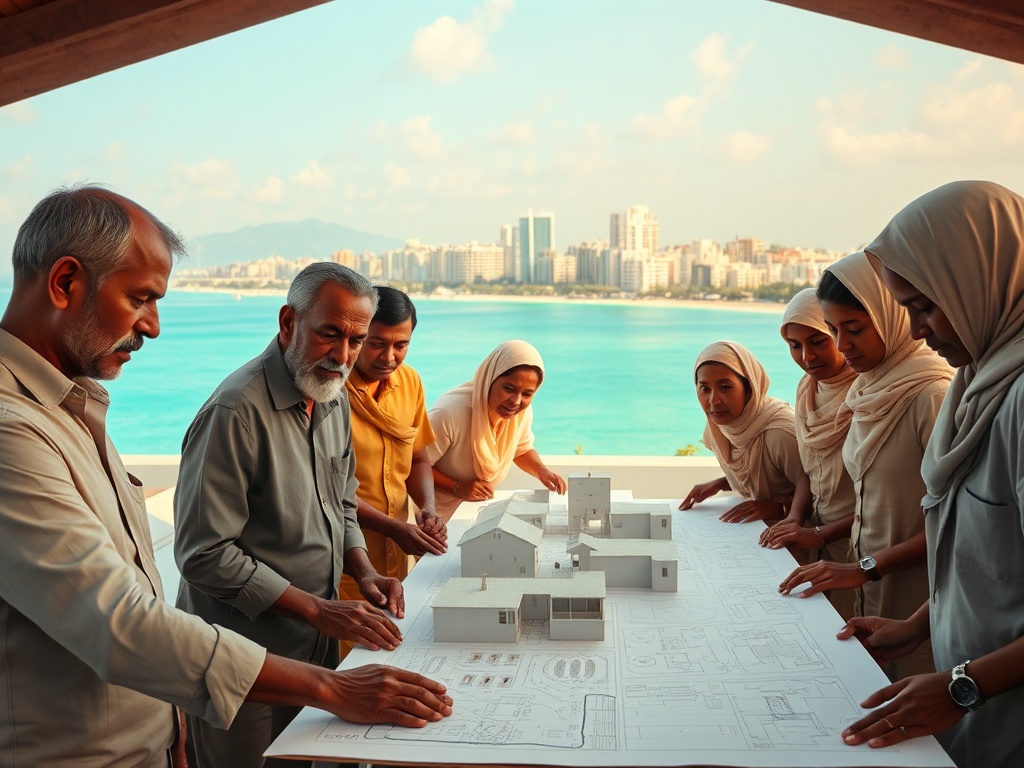
Parliament Rushes Housing Bill as Malé's Skyline Crowds
The debate over housing in Maldives has reached a critical juncture, with Parliament's sudden scheduling of committee meetings to review the Housing Bill signaling political urgency. Yet beneath the legislative maneuvering lies a fundamental tension between perceived entitlements and equitable policy-making.
Across social media and public discourse, a persistent narrative frames the housing crisis as a conflict between 'Malé Meehaa'—native residents of the capital—and those from the atolls. Some argue that demands for housing benefits often mask straightforward financial expectations, with one observer noting, 'People are saying give me money because I am Malé Meehaa.' Yet this framing obscures the complex reality that Malé's real estate ecosystem involves developers, managers, and investors from across the archipelago, distributing economic benefits far beyond the capital's native population.
The core challenge emerges from conflicting policy approaches. On one side, schemes like the MDP's 'Goathi' program are recognized for addressing genuine needs at lower costs, though criticized for unconstitutional implementation. On the other, market-based arguments caution against price ceilings that could spawn black markets, suggesting regulated percentage increases as more effective tools.
What's becoming increasingly clear is that the solution lies not in pitting Maldivians against each other based on birthplace, but in developing holistic national strategies. The proposed Housing Bill's attempt to standardize social housing schemes and require comprehensive national planning represents a step toward this systematic approach. By mandating housing surveys and development plans that government must follow, the legislation could introduce much-needed consistency.
Critics of current systems emphasize that housing criteria should transcend geographical origins, professions, or other discriminatory markers. The principle of equal access regardless of island of birth is gaining traction as a foundational element of fair housing policy. This perspective acknowledges that while individuals will naturally seize available opportunities, the responsibility lies with successive governments to create frameworks that don't force citizens into zero-sum competitions for basic needs.
The path forward requires balancing immediate relief with sustainable systems. Rent regulation, social housing accessibility across islands, and research-driven policies all have roles to play. As one commentator noted, understanding the crisis demands genuine knowledge gathering—visiting communities, listening to residents, and building policies from evidence rather than political expediency.
Ultimately, the housing conversation is evolving from entitlement debates toward recognition that a crowded Malé affects all Maldivians, and solutions must serve the nation collectively. The current legislative moment offers an opportunity to build systems where housing becomes a right accessible through clear, consistent criteria rather than a political bargaining chip distributed along geographical or partisan lines.
— Source fragments: Debate about 'Malé Meehaa' expectations; discussion of MDP's Goathi scheme implementation; analysis of price ceilings and rent regulation; details about Parliament's Housing Bill process; arguments against birthplace-based discrimination; calls for holistic national approaches