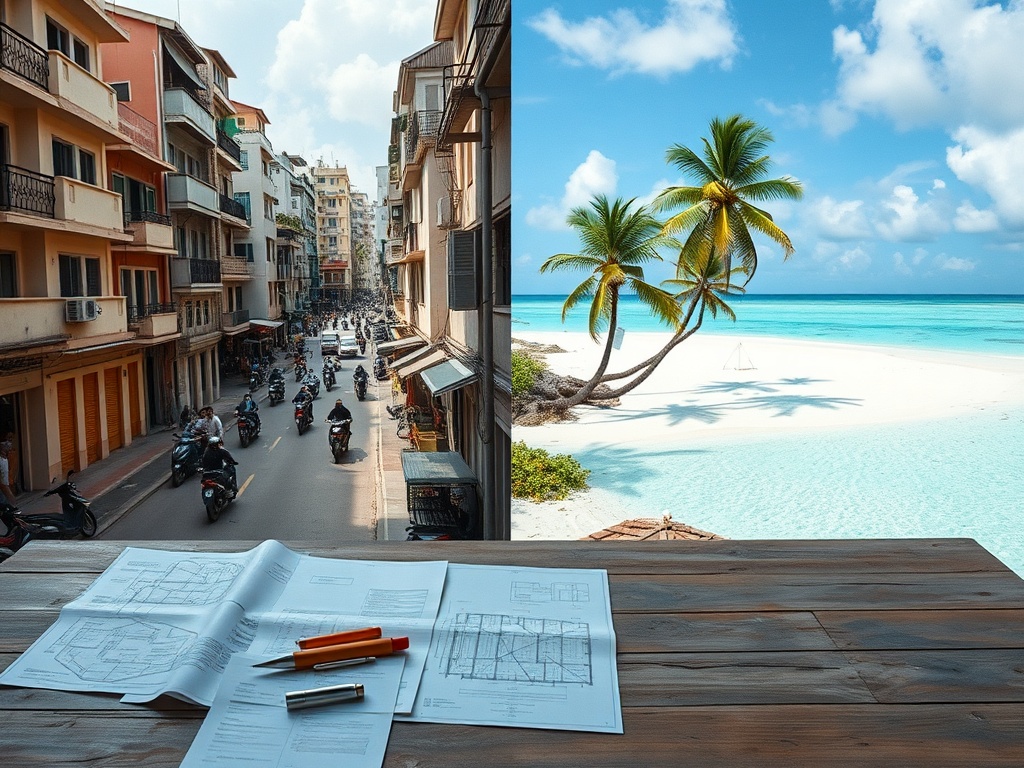
Parliament's Fast-Tracked Housing Bill Splits Malé's Crowded Streets from Empty Islands
The Housing Bill now moving rapidly through Parliament committees represents more than just policy—it's a mirror reflecting the deep social fractures and competing visions of fairness in contemporary Maldives. At its core, the legislation aims to standardize government housing schemes and mandate a national development plan based on comprehensive surveys. But the technical framework belies the emotional landscape it navigates.
Across social media and coffee shops, the conversation has shifted from simple demand for shelter to fundamental questions about belonging and entitlement. The perception that Male' residents receive preferential treatment fuels resentment, while others argue this misdiagnoses the problem. "It's not they don't know—people have eyes and can see that Male' is full," observes one perspective. "What people are demanding is money. They're saying give me money because I am Male' meeha."
Yet this framing overlooks the complex economic ecosystem that has developed around housing. The rent control debate reveals how market interventions create unintended consequences. When demand far exceeds supply, price ceilings below market rate often backfire, spawning black markets where units rent illegally at higher prices. International experience suggests regulating percentage increases rather than imposing absolute caps.
The geography of ownership further complicates the picture. While land in the capital is generally owned by Male' natives, real estate development and management involve stakeholders from across the archipelago. The income stream from rent thus circulates nationally, not just within the capital.
Previous schemes like MDP's Goathi program demonstrate both the potential and pitfalls of housing policy. The concept itself—solving a real problem at lower cost—earned praise from policy analysts. But implementation through "obviously unconstitutional and biased" methods undermined its effectiveness and public trust.
The fundamental tension lies between universal principles and identity-based claims. Advocates for reform argue that housing criteria should not consider place of birth or profession. "Don't discriminate among residents on any island," insists one viewpoint. This aligns with calls for a holistic national approach where everyone can access land equally, regardless of origin.
As the legislative process accelerates, the challenge remains balancing immediate political pressures with sustainable long-term solutions. The housing crisis didn't emerge overnight, and successive governments share responsibility for the current predicament. The solution requires moving beyond blame toward evidence-based policy that acknowledges both economic realities and the legitimate aspirations of all Maldivians.
What emerges is a consensus that temporary fixes and politically motivated allocations only deepen the problem. The path forward demands transparent criteria, national planning that considers regional development, and recognition that in a nation of scattered islands, housing policy is ultimately about national cohesion.
— Source fragments: Male' congestion observations, rent control economics, housing bill legislative process, policy implementation challenges, universal vs identity-based allocation arguments