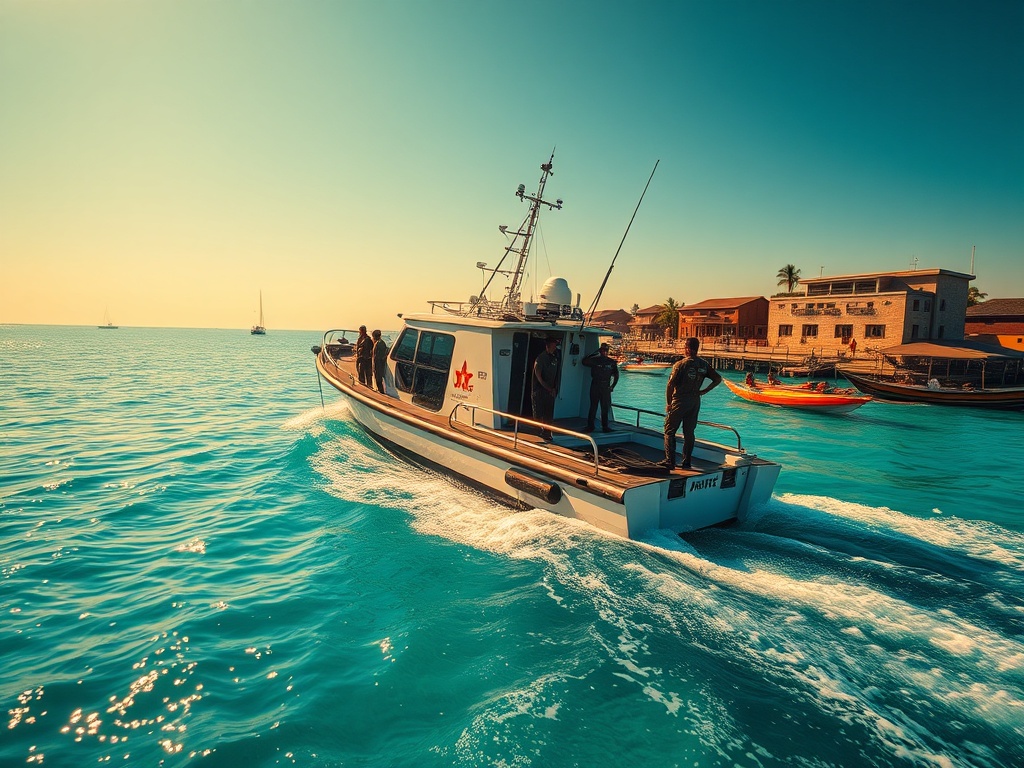
Patrol Boats and Sovereignty in the Maldives' Strategic Waters
The conversation around Maldives' defense strategy has intensified in recent months, evolving beyond simple budget allocations to fundamental questions of national sovereignty. Proponents of increased military spending argue that in a nation of scattered islands across strategic sea lanes, defense capability represents more than protection—it's a crucial element of diplomatic leverage.
This perspective draws inspiration from Singapore's model, where despite being a small city-state, substantial defense investment has created what analysts describe as a "poison shrimp" doctrine—not threatening enough to provoke major powers, but sufficiently armed to make aggression costly. The parallel resonates in Maldivian discourse, where some see military modernization as essential for strengthening the country's negotiating position with regional partners.
Yet the debate reveals deeper tensions. Critics point to nations like Iceland, which maintains zero military expenditure while ranking among the world's safest countries. They question whether limited resources might be better directed toward pressing domestic needs—healthcare shortages, youth unemployment, and housing crises that affect daily life across the archipelago.
The current government's defense investments, including rehabilitation of MNDF facilities, reflect a pragmatic approach. Rather than aspiring to match regional powers, the focus appears to be on developing credible surveillance capabilities and professional forces. The discussion around arming populations has been carefully framed around trained, responsible ownership rather than widespread distribution, drawing comparisons to Switzerland's regulated model.
Underlying these technical discussions is a broader philosophical question: what constitutes true security in the 21st century? For some, it's the ability to monitor territorial waters and respond to emerging threats. For others, security means economic stability, reliable healthcare, and opportunities for the next generation.
As drone technology and surveillance systems become more accessible, the calculus shifts. The strategic value of the Maldives' exclusive economic zone makes maritime domain awareness increasingly vital. Yet the purpose of more advanced weaponry remains contested, with some questioning whether missiles represent practical defense or symbolic posturing.
What emerges is not a binary choice between military strength and social welfare, but a complex balancing act. The Maldives must navigate its geographic reality as both vulnerable and strategically significant, its economic constraints as both limitation and incentive for efficiency, and its sovereignty as both principle and practice in an interconnected region.
The defense conversation ultimately reflects a nation determining its place in a changing world—one where traditional notions of security are being redefined, and where a small island nation's voice must be backed by both capability and conviction.
— Source fragments: Singapore military spending comparison, sovereignty arguments, defense as negotiation strength, Iceland zero military budget counterpoint, practical versus symbolic weaponry discussions, professional force development mentions