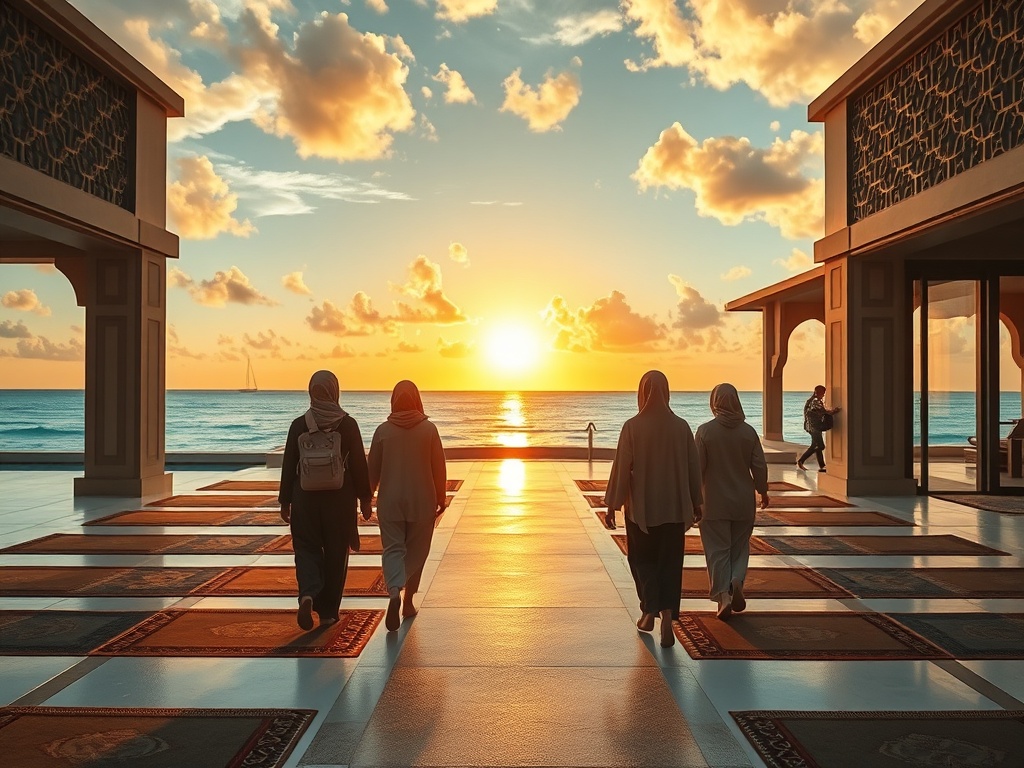
Prayer Mats on the Resort Deck: Halal Tourism's New Frontier
In the Maldives, where Islam forms the bedrock of national identity, the concept of halal tourism is gaining traction beyond mere marketing terminology. The discussion reveals a nuanced understanding of how religious principles intersect with commercial hospitality in an archipelago dependent on tourist dollars.
The theological foundation remains clear: Islamic guidelines on modesty and worship are non-negotiable for many Maldivians. The Quranic mandate for women's hijab represents an established religious obligation, while other practices like head covering for men who emulate the Prophet bring spiritual rewards. These religious principles now find expression in the emerging halal resort model, which extends beyond food to encompass prayer time announcements, Eid celebrations, and modest dress codes in public areas.
Yet the conversation acknowledges a critical distinction between religious law and business strategy. Halal hospitality operates as both spiritual commitment and market positioning—a way to serve Muslim travelers seeking environments aligned with their values while tapping into a growing niche market. This dual nature reflects the Maldivian reality where ancient faith meets modern economics.
The practical implementation reveals thoughtful adaptation. Rather than rigid uniformity, the approach allows for variation in how modesty is observed—whether through hijab, burqa, or niqab—suggesting a focus on the principle rather than the particulars. Similarly, leadership virtues like God-fearing sincerity transcend specific governance systems, indicating a universal ethical framework that can operate within diverse political contexts.
As the Maldives navigates its position as both a Muslim nation and global tourist destination, the halal tourism model represents more than a business category. It embodies the ongoing negotiation between preserving religious identity and engaging with the international marketplace—a balancing act that will likely define the future of Maldivian hospitality.
— Source fragments: Hijab for women is Obligatory by the explicit command in the Quran; if aman covers his head intending to imitate the Nabi ﷺ, he will be rewarded; What should a halal resort be like?; it's a business and marketing concept used to reach a niche market; the concept will have halal f&b across the hotel, prayer times are announced, Eids are celebrated, have a modest dress code in public areas