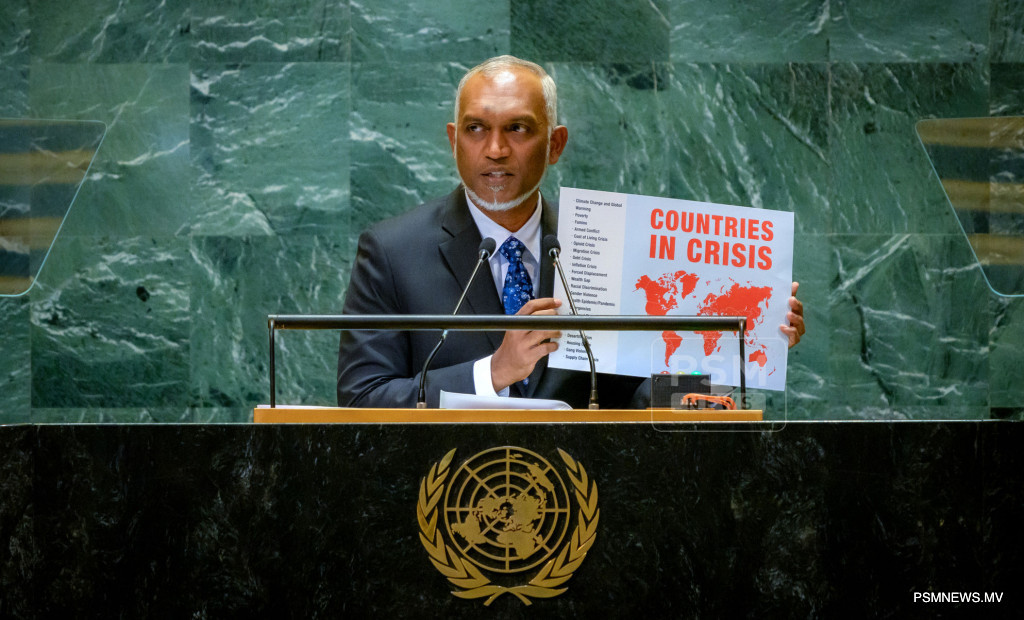
President Muizzu Calls for Greater Maldivian Influence in United Nations Reform
President Dr. Mohamed Muizzu has declared that the Maldives is prepared to take a more influential role in shaping the United Nations as the country commemorates 61 years of membership in the international body.
In a message marking the anniversary, the President noted that while the Maldives joined the UN in 1965 seeking recognition and partnership, the nation has now evolved into a state capable of contributing significantly to a resilient global future. He emphasized a commitment to advocating for meaningful reform and equitable representation within the organization, specifically to advance the priorities of Small Island Developing States (SIDS).
President Muizzu underscored that the Maldives will continue its collaboration with the UN to ensure that the voices of SIDS are integrated into the creation of a climate-resilient and equitable global economy. Key areas of focus include advocating for sustainable debt solutions, improving access to affordable financing for climate adaptation, and expanding capacity-building opportunities for smaller island nations.
Reflecting on six decades of partnership, the President acknowledged the UN's pivotal role in the Maldives' development, including the country's successful graduation from Least Developed Country status. He highlighted that this partnership remains essential as the Maldives pursues its national ambition to become a fully developed nation by 2040.
To further this influence, the President pointed to the Maldives' increasing engagement within the UN system. This includes serving as Vice-President of the General Assembly and the Human Rights Council, alongside upcoming memberships in the Economic and Social Council and the Commission on the Status of Women. The administration is also actively pursuing elections for the Security Council and the Human Rights Council.
Closing his message, President Muizzu reaffirmed the nation's adherence to international law and the UN Charter. He stressed that diplomacy, inclusive multilateral governance, and open dialogue are the only viable tools for addressing the increasingly complex challenges facing the modern world.