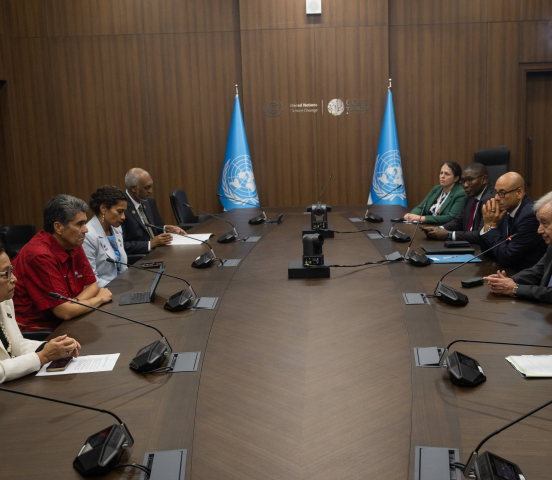
President Muizzu Calls for Reform of International Financial System to Ensure Climate Finance
President Dr. Mohamed Muizzu has called for reform of the international financial system to ensure that the vulnerability of Small Island Developing States (SIDS) does not become an obstacle to obtaining climate finance easily.
He made this statement while speaking at a meeting held with the leaders of the Alliance of Small Island States (AOSIS) and the UN Secretary General on the sidelines of COP31.
In the President's remarks, he noted that as the Maldives aims to become a developed nation by 2040, one of the biggest obstacles to reaching this goal is climate change. He further stated that the greatest priority now must be placed on climate finance, reforming the financial system, and carrying out practical work based on implementation.
Highlighting climate finance, the President said that climate finance, or financial assistance given for climate purposes, must become something provided in adequate amounts, easily, with certainty, and as free assistance. In particular, he called for increasing adaptation finance, with reference to the effects of the predicted "Super El Niño," and for the "Loss and Damage Fund" to be quickly funded and completed.
He stated that countries that have contributed the least to the creation of this issue must not be forced to take on debt at high interest to confront this crisis. He further stated that measures taken against climate change must not become something that hinders development or requires carrying a debt burden that vulnerable countries cannot bear.
Speaking on reforming the financial system, the President noted that the arrangements through which financial assistance is currently provided have forced vulnerable countries to take on debt at high cost. And he noted that this further increases the debt burden of those countries and narrows the fiscal space for spending. Therefore, he called on international financial institutions and credit rating agencies to weigh the long-term economic benefits of investments made to increase resilience against losses from climate change.
Highlighting the importance of implementation, the President said that promises made regarding climate change must be turned into things that show practical results. He welcomed the initiatives begun at COP31 on global electrification, waste management, the circular economy model, and building climate-resilient cities. He also noted that these efforts must receive adequate financial assistance, provision of technology, and assistance in practical implementation.
The President affirmed that small island states are not asking for charity or sympathy, but that those countries are asking for climate justice. He stated that the true test of multilateralism is not the promises made, but the results delivered.
Concluding the President's remarks, he sincerely thanked UN Secretary General António Guterres for the steadfast support given to Small Island Developing States during his tenure. And as his tenure approaches its end, he conveyed good wishes to him.