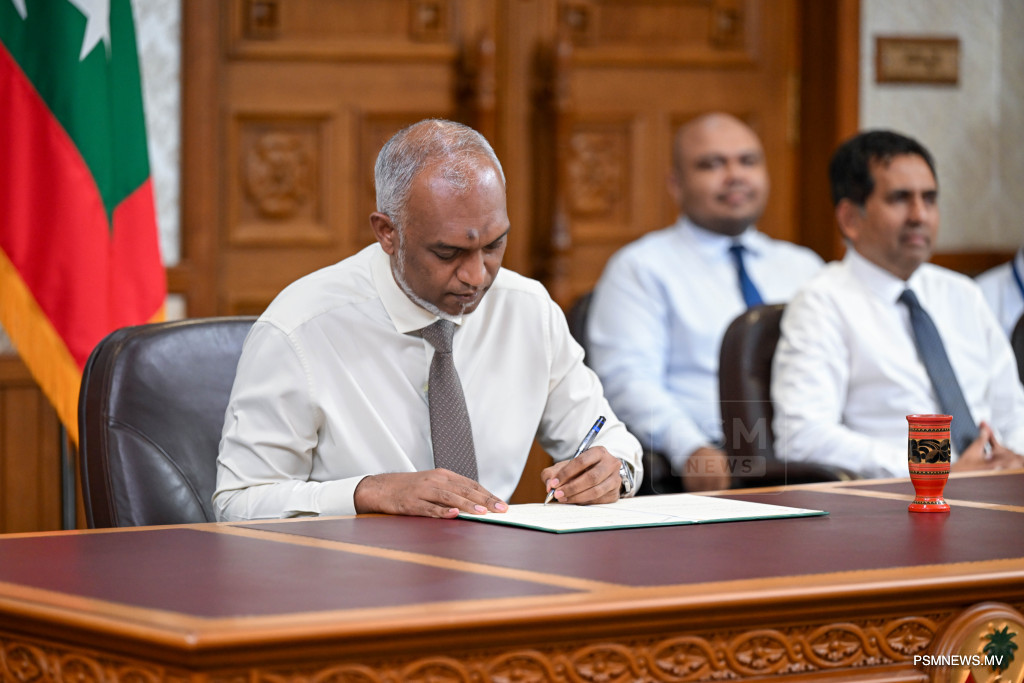
President Muizzu Outlines 10-Year Plan to Establish Rufiyaa-Dominant Financial System
President Dr. Mohamed Muizzu has announced a strategic, 10-year roadmap to transition the Maldives away from its heavy reliance on foreign currency and establish a financial system primarily centered on the Maldivian Rufiyaa (MVR).
Addressing the nation's economic outlook, the President explained that while creating an MVR-centric framework has been a long-term goal for successive administrations, the complexity of the current system requires a phased approach. He emphasized that a rapid shift is unfeasible due to the deep integration of foreign currencies within international investments, sovereign loans, and global financial commitments.
"This is not something that can be done overnight," President Muizzu stated, noting that the transition is intricately linked to the country's existing financial obligations. He estimated that a full transition to a local-currency-dominant system will take approximately a decade to implement safely.
At present, the Maldives operates under a mixed financial system where foreign currencies—particularly the US dollar—circulate with minimal restrictions in an open-market environment. The President noted that this arrangement deviates from standard international practices, where most nations require foreign exchange to be converted into the official local currency before domestic transactions can occur.
Because foreign currency is so deeply embedded in the local economy, the administration believes that dismantling the current framework requires a meticulous, step-by-step evaluation to avoid economic disruption. By categorizing economic priorities and fostering coordination across all financial institutions, the government aims to gradually reshape the monetary landscape.
The ultimate goal of this decade-long transition is to strengthen the national currency and fortify the Maldives' economic sovereignty, reducing the vulnerability associated with fluctuations in global foreign exchange markets.