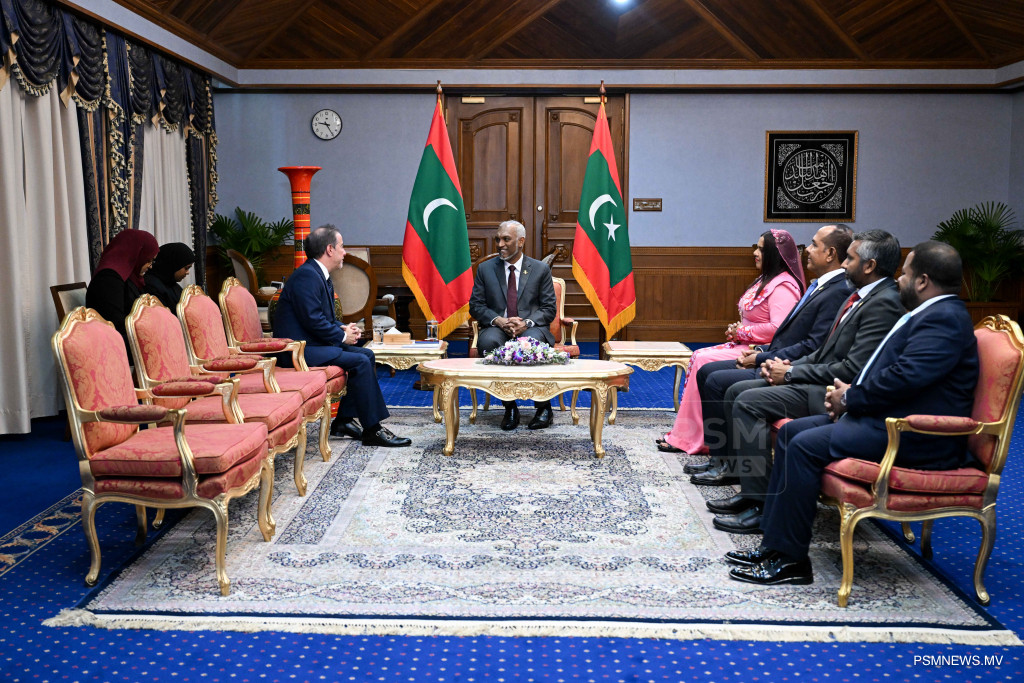
President Muizzu Receives Credentials from Five Non-Resident Ambassadors to Expand Ties
President Dr Mohamed Muizzu formally received Letters of Credence from five non-resident ambassadors, marking a strategic push to broaden the Maldives' diplomatic reach across the Caribbean, Europe, and Africa. The ambassadors representing the Dominican Republic, Cuba, Kosovo, Slovenia, and Somalia were received in separate ceremonies at the President's Office.
Each diplomat arrived via a traditional Haiykolhu cultural procession, escorted by the Maldives National Defence Force (MNDF) Drum and Trumpet Band, upholding the nation's ceremonial protocols for welcoming foreign envoys.
In discussions with Ambassador Francisco Manuel Comprés Hernández of the Dominican Republic, President Muizzu focused on the shared challenges of Small Island Developing States (SIDS). Both nations pledged to collaborate more closely on the blue economy and environmental protection to combat the urgent threats of climate change.
Cooperation with Cuba centered on human capital development, specifically in healthcare, higher education, and sports. Ambassador Patricia Lázara Pego Guerra highlighted the importance of the Maldives' ongoing support at the United Nations, while both nations looked to strengthen ties in volleyball and professional training.
Engagement with the Republic of Kosovo focused on youth development and education, with the President expressing gratitude for scholarships provided by the Kosovar government. Meanwhile, discussions with Ambassador Tomaž Mencin of Slovenia emphasized sustainable development and the mutual expansion of the tourism sector.
Finally, the President met with Ambassador Dr Abdullahi Mohammed Odowa of Somalia. Their dialogue prioritized regional stability, with a specific focus on promoting peace and security within the Indian Ocean region.
These diplomatic exchanges reinforce the Maldives' commitment to diversifying its international partnerships. By focusing on tangible outcomes in trade, health, and climate resilience, the administration aims to translate these diplomatic formalities into sustainable benefits for the Maldivian people.