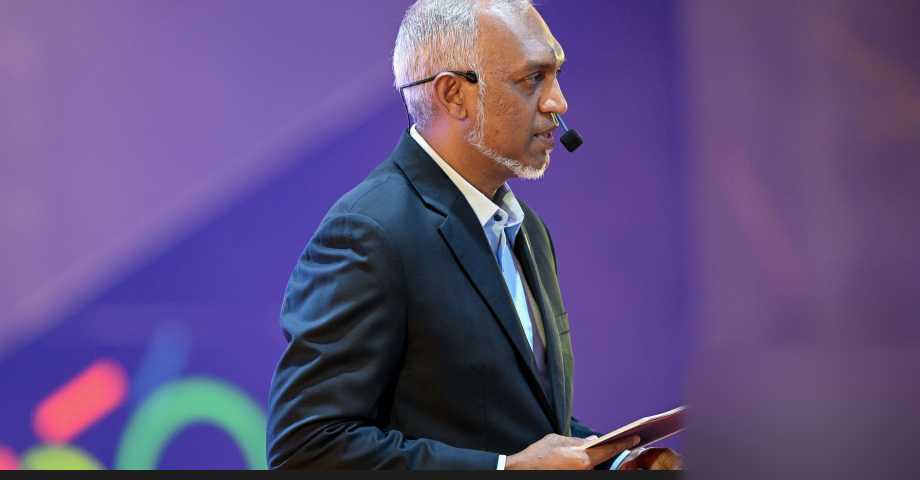
President Muizzu Says Government Will Make Unpopular Decisions if Beneficial to Country
President Dr. Mohamed Muizzu has said that even if a decision is highly unpopular among the public, the government will not hesitate to implement it if it is sincere and benefits the country. He made the remarks while speaking at the official ceremony held to mark three years of this government.
The President noted that some decisions made by the government, even if temporarily unpopular, are made in the interests of future generations. He cited the ban on vaping and the generational ban on tobacco use as examples. He also said that although some parties in the tourism sector expressed concern when the decision was made to ban Israeli passports, the decision was taken by giving priority to the national interest.
The President said, "Even if it is unpopular, if it is something beneficial to the country, however unpopular it may be, if I, with sincerity towards the country, intend it, I will do it." He added that without regard to the labels people use politically, he will give the highest priority to the country.
Shedding light on the education sector, the President said that when this government took over, only 37 percent of students completing O-Level went on to A-Level, and that through the work of the past three years that proportion has now been raised to 46 percent. He also noted that a special vocational school has been established to expand vocational education, with students being trained in fields such as architectural designing and engineering.
On higher education expenditure, the President revealed that 2.6 billion rufiyaa has been spent during the past three years, including scholarships, free degrees and loans. He said opportunities for higher education have been opened to 11,000 children without leaving out any eligible child. Among them are 502 students studying medicine, 451 in engineering, 634 in nursing, 672 in teaching, 307 in therapy and counselling, and 920 in accounting. He also said that higher education projects have been started on 21 islands to allow students to study while staying on the islands.
Noting that students studying at state expense must return and serve the country, the President said regulations have now been reformed to recover the expenditure incurred by the state from students who complete their studies and do not return to the country without a valid excuse.