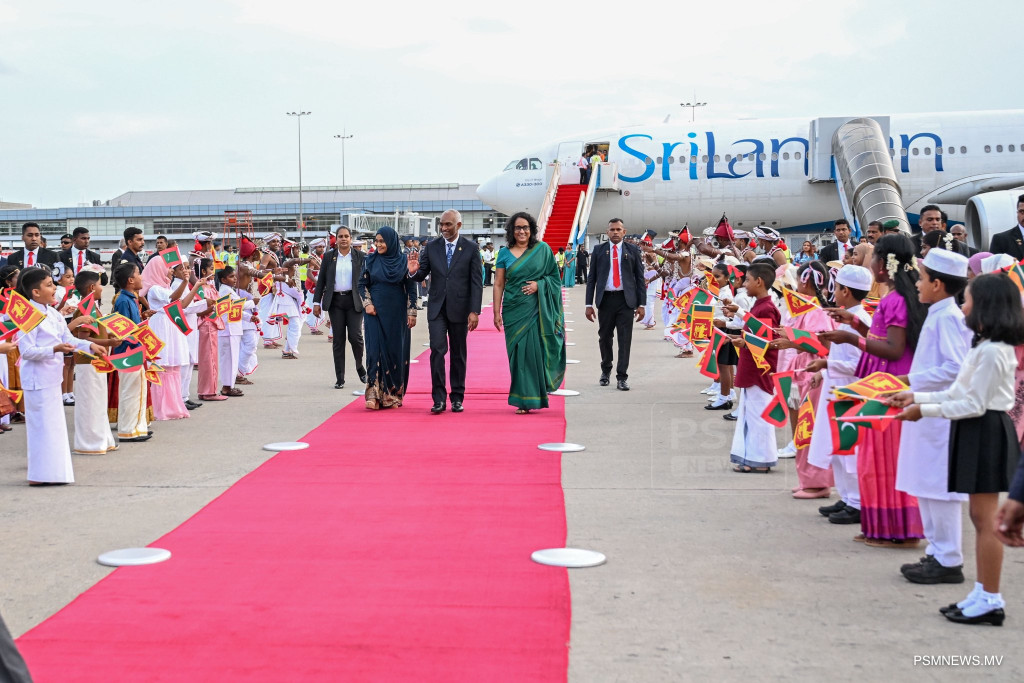
President Muizzu Visits Sri Lanka to Strengthen Bilateral Ties and Economic Cooperation
President Dr. Mohamed Muizzu has arrived in Sri Lanka for an official state visit aimed at deepening the strategic partnership between the two neighboring nations. Accompanied by First Lady Sajidha Mohamed, the President arrived this evening following a formal invitation from Sri Lankan President Anura Kumara Dissanayake.
The visit, which concludes on May 6, focuses on expanding collaboration across several key sectors. President Muizzu is scheduled to hold high-level talks with senior Sri Lankan officials to discuss shared priorities in education, vocational training, governance, and economic development. Both leaders are also expected to coordinate on international affairs and the preservation of cultural heritage.
To formalize these agreements, several Memorandums of Understanding (MoUs) will be signed during the visit. These documents are intended to create a framework for enhanced cooperation, ensuring that the diplomatic relationship translates into tangible benefits for both citizens.
Beyond government diplomacy, President Muizzu will engage with the private sector by participating in the Maldives–Sri Lanka Business Forum. This initiative seeks to identify new investment opportunities and foster stronger trade links between the two economies. Additionally, the President will meet with members of the Maldivian diaspora living in Sri Lanka to discuss their welfare and community needs.
According to the President’s Office, this visit is a critical step in reinforcing the longstanding friendship between the two countries. The diplomatic engagement follows a recent state visit by President Dissanayake to the Maldives from July 28 to 30, 2025, which coincided with the 60th anniversary of their diplomatic ties.
The Maldives and Sri Lanka officially established diplomatic relations on July 26, 1965. This latest visit serves as a continuation of those six decades of cooperation, emphasizing a shared commitment to regional stability and mutual prosperity.