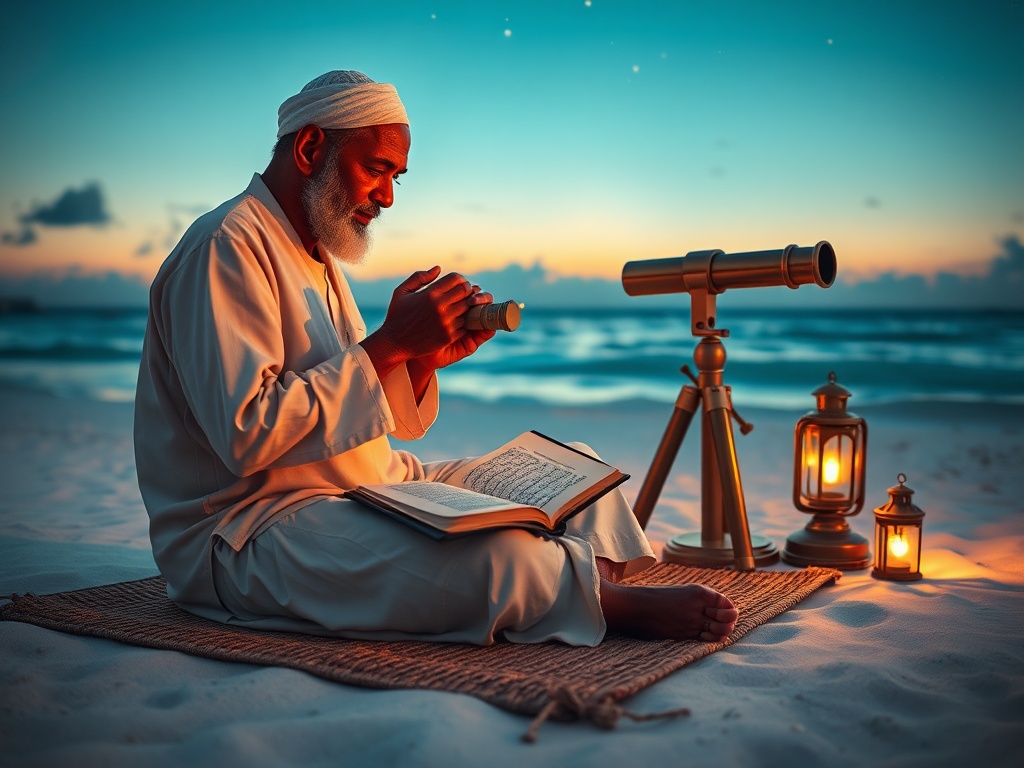
Quran in One Hand, Telescope in the Other: Maldivians Rethink Creation
In the quiet evening prayer halls of Malé and across the scattered atolls of the Maldives, a quiet conversation unfolds among educated Muslims—one that mirrors debates occurring throughout the Islamic world. The relationship between religious texts and scientific theories presents both intellectual challenge and spiritual opportunity for a nation where faith forms the bedrock of national identity.
The debate often centers on whether the Quran must validate scientific discoveries, or whether science must conform to Quranic interpretation. Some argue passionately that the Quran represents absolute truth—the standard against which all theories must be measured. For them, the Big Bang Theory either aligns with Islamic scripture or stands invalidated by it. This perspective sees religious text as the ultimate arbiter of scientific truth.
Yet others approach the matter differently, questioning the very need to seek validation between domains they see as operating in separate spheres. Why stretch religious understanding to validate a scientific theory that, by its nature, makes no claims about divine intention? This view suggests that scientific inquiry and religious faith can coexist without requiring constant reconciliation.
The discussion reveals deeper questions about interpretation itself. How would early Islamic scholars, transported to our time, react to modern scientific concepts? Some suggest they might reject theories that appear to separate natural phenomena from divine action. The Big Bang Theory, in its standard scientific formulation, describes cosmic origins without addressing the question of who initiated the process—a distinction that matters profoundly in theological contexts.
In the Maldivian context, where religious education forms part of the national curriculum and scientific literacy grows alongside traditional learning, these conversations take on particular significance. The archipelago's isolation has historically preserved religious traditions, while modern education and global connectivity introduce new ways of understanding the universe.
The tension isn't merely academic. It touches on how a society navigates change while maintaining core beliefs. When scientific theories emerge, must they be immediately measured against religious texts? Or can they be appreciated as human attempts to understand creation, while religious faith addresses deeper questions of purpose and meaning?
What emerges is a spectrum of approaches—from those who see complete harmony between Quranic verses and scientific discovery to those who maintain clear boundaries between different types of knowledge. The middle ground acknowledges that while the Quran contains truths about the natural world, its primary purpose is spiritual guidance rather than scientific textbook.
As Maldivians continue this conversation, they contribute to a broader Islamic discourse about faith in the modern age—one that respects religious certainty while making space for human inquiry into the magnificent complexity of creation.
— Source fragments: User discussions about Big Bang Theory, Quran as absolute standard, validation between religious texts and scientific theories, questioning the need for reconciliation between domains