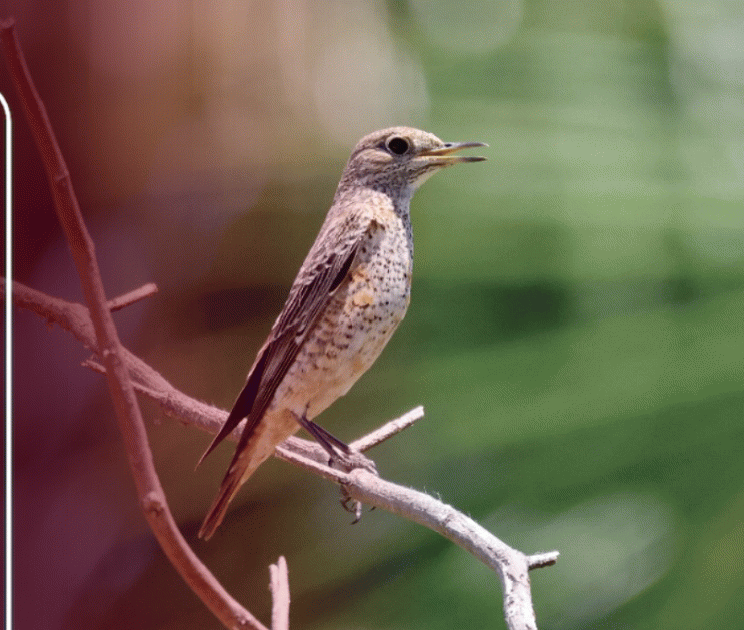
Rufous-tailed Rock Thrush Spotted in Mulah, First Record for Maldives
A bird species never before recorded in the Maldives, the Rufous-tailed Rock Thrush, has been spotted and officially documented in M. Mulah. The finding was announced in a special scientific report issued two days ago by the Environmental Regulatory Authority (EPA).
The bird was sighted during a survey conducted in Mulaku Atoll from 26 to 30 October 2024 by an EPA team to identify ecologically special and protected areas. According to the EPA report, two birds of the species were seen on the morning of 29 October 2024 in an area used for agriculture in Mulah. A photo of one of the birds perched in front of a tree was taken by the authority's Hussain Shufraan. The birds were seen again in the same area the following day, 30 October, and more photos were taken.
The report, compiled by Yusuf Rizwan, Hussain Shufraan, Mohamed Aiman and Ahmed Basheer, notes that this is the first time the bird has been recorded from the Maldives, both in the country's history and in the international bird databases Avibase and eBird. As it is a bird entirely new to the Maldives, a Dhivehi name has not yet been assigned to it.
The Rufous-tailed Rock Thrush is generally found in mountainous areas of Europe, the Middle East, Africa and China. It is a ground-dwelling bird with a blue-grey head and neck and brownish-orange breast and underparts. While it is a migratory bird commonly seen in the northern regions of India, it has previously been seen very rarely in the southern regions.
According to the EPA, the Maldives is an important stopover destination for migratory birds on the Middle Asian Flyway, and such new birds may come to the Maldives due to changes in weather or by getting lost on their route. The authority said the new discovery will provide important information for identifying bird migration routes in the Indian Ocean region and for further studying the richness of the Maldives' biodiversity.