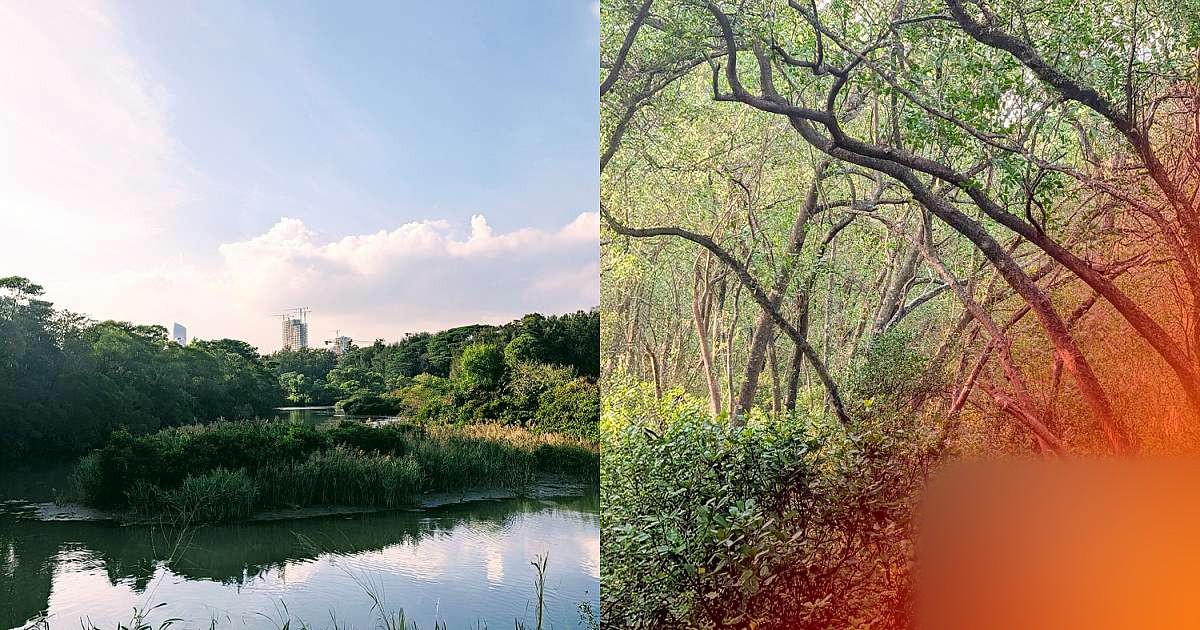
Shenzhen's Mangrove Park Offers Blue Carbon Lessons for Maldives' Wetlands
Shenzhen, China – In a city known for towering buildings, advanced technology and robots, the Futian Mangrove Ecological Park stands as proof that concrete development and the natural environment can coexist. The park is located on the eastern side of Shenzhen's coast, where the Xinzhou River and the Shenzhen River meet.
Opened in 2015, the approximately 38-hectare Futian Mangrove Ecological Park serves as a buffer zone protecting the adjacent 367.6-hectare Guangdong Neilingding Futian National Nature Reserve. Although it is China's smallest national nature reserve, it is the only such reserve located in the middle of a large city, and it is included in the Ramsar Wetland list.
Shenzhen took several steps to protect the mangroves. When the Binhai Boulevard highway was planned in 1994, its route was shifted more than 200 meters north to avoid damaging the mangrove's main area. A 500-meter noise barrier dedicated to bird protection, the first of its kind in China, was established to reduce disturbance from traffic. Construction of tall buildings near the mangrove area is strictly controlled to prevent obstruction of migratory birds' flight paths and collisions with glass buildings. Shenzhen also became the first city in China to make it mandatory by law to control bright lights at night near migratory bird habitats.
The results are visible in the numbers. While mangroves are disappearing in various parts of the world, Shenzhen's mangrove area increased from 281.51 hectares in 2000 to 526.43 hectares by 2022.
More than 270 species of birds have been recorded in the Futian mangrove area alone, and approximately 100,000 migratory birds come to rest on Shenzhen's coast each cold season. The Black-faced Spoonbill, feared to be disappearing, rose from 82 birds recorded in the area in 1994 to 328 by 2025, with more than 150 spending the night in the Futian mangrove waters. Trees damaging the mangrove were removed from an 18-hectare area and mangroves were newly restored, while digital systems control pond water levels so birds can get food. Educational programs are conducted with volunteers, and the International Mangrove Center was officially established in Shenzhen in November 2024.
Shenzhen also entered the Blue Carbon market, a system in which coastal ecosystems such as mangroves and seagrass meadows absorb carbon dioxide and store it in plants and mud. In September 2023, Shenzhen held China's first-ever Mangrove Carbon Sink auction. The 3,875 metric tons of carbon credits generated from protecting the Futian Mangrove Reserve were opened for sale at 183 yuan per ton (approximately 25.5 dollars). When the competitive auction ended, the credits sold at a record 485 yuan per ton (approximately 68 dollars), the highest price obtained in China's carbon market at that time. From this auction alone, Shenzhen received approximately 1.88 million yuan (260,000 dollars, or more than 4 million rufiyaa). The money is spent through the state treasury on further protecting the mangroves, restoring wetlands and environmental research.
The article notes that the Maldives has naturally rich wetlands and nature parks on many islands such as Addu, Fuvahmulah, N. Kendhikulhudhoo and H.Dh. Naikurendhoo, but these parks have to rely on the state budget or small ticket income. It suggests that a robust system for selling blue carbon or green carbon credits in the Maldives could turn wetlands and mangroves into valuable resources providing financial benefits to councils and residents, making protection economically more beneficial than reclamation.