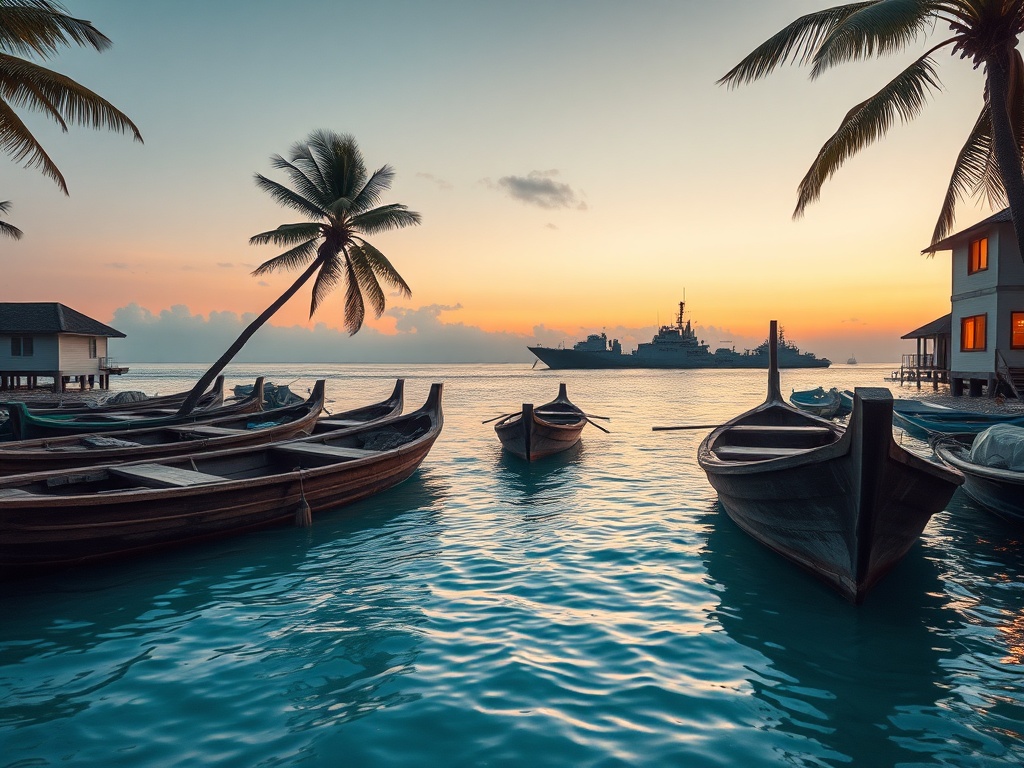
Strategic Waters, Shifting Currents
From the water, it looks like any other Maldivian island—the same white sand beaches, the same turquoise lagoon, the same coconut palms leaning toward the sea. But there's a different energy here, one that doesn't come from tourists or fishing boats. The vessels anchored offshore have cleaner lines, move with more purpose. The buildings, while designed to blend, have a sturdiness that speaks to something beyond luxury.
We've always lived between worlds here—between the deep blue of the ocean and the bright blue of the sky, between traditional dhoni boats and modern seaplanes. But this new presence feels different. It's not about hospitality or fishing or even the usual government business. The men who come ashore don't wear resort uniforms or carry fishing gear. They move with the quiet efficiency of people who aren't here for the scenery.
Local fishermen still navigate these waters as they have for generations, reading the currents and reef formations with inherited knowledge. But now they give wider berth to certain areas, following new, unspoken boundaries. The resort workers who commute from nearby islands speak in lowered voices about restricted zones and security protocols that weren't there last season.
There's a tension in the air that has nothing to do with the monsoon winds. It's in the way conversations pause when certain topics arise, in the careful neutrality of official statements, in the extra layers of paperwork required for simple supply runs. The island still functions as a resort—guests still enjoy sunset cocktails and spa treatments—but there's an awareness of dual purposes, of overlapping realities.
We Maldivians have always understood that our geography gives us both vulnerability and value. For centuries, it was about trade routes and fishing grounds. Then it became about tourism and natural beauty. Now, in this new era of shifting alliances and regional positioning, our islands carry different kinds of weight. The same sea that brought us visitors now brings different kinds of attention. The same strategic location that made us a crossroads for ancient mariners now makes us pieces in larger games.
The ocean hasn't changed. The atolls haven't moved. But the meaning of this place, this particular dot in the Indian Ocean, is being rewritten by currents far beyond our shores.
— Source fragments: Island looks more like a strategic nacal base than a resort.