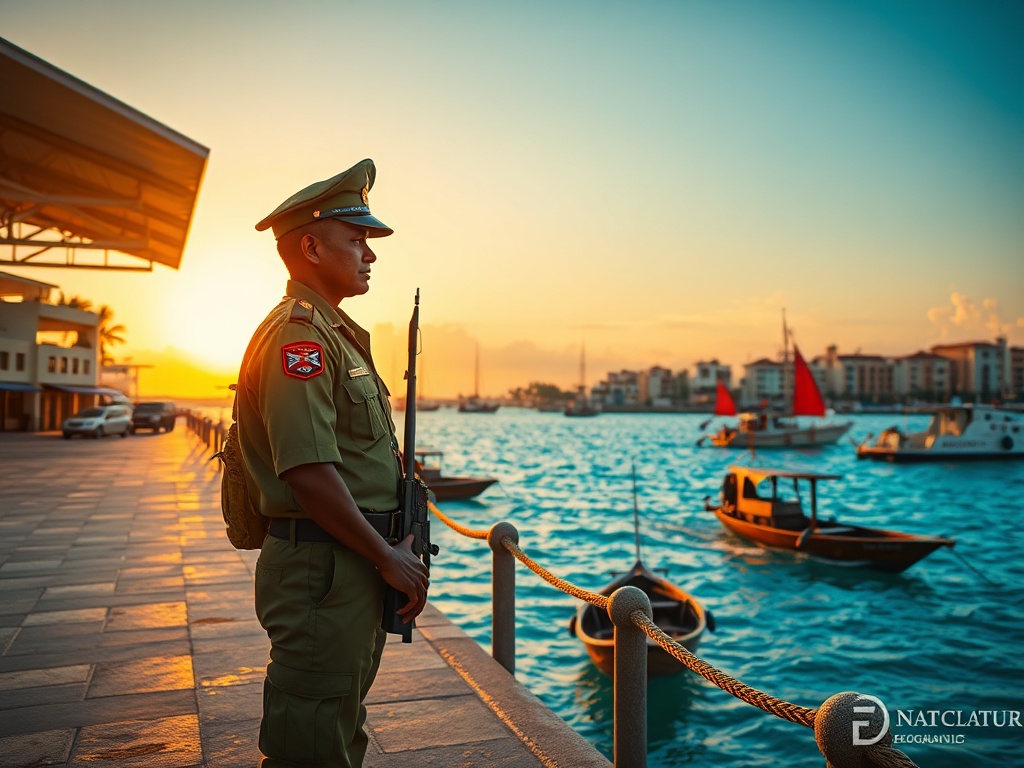
Sunset Watch at Malé Harbor: The Soldier and the Sovereignty Question
The conversation around military expenditure in the Maldives has intensified, revealing a nation grappling with its place in an increasingly complex geopolitical arena. At its core lies a fundamental question: how does a small island nation secure its sovereignty without compromising its economic stability or regional relationships?
The argument for enhanced defense capability draws parallels to Singapore's model—a small nation that has chosen to invest heavily in military readiness despite its size. Proponents argue this isn't about preparing for conventional warfare but about strengthening negotiating positions and demonstrating sovereign resolve. The underlying philosophy suggests that credible defensive capability creates diplomatic leverage, making external powers more likely to approach negotiations with respect rather than presumption.
This perspective challenges the notion that military investment is only justified by imminent threat. Instead, it frames defense spending as a form of strategic insurance—akin to privacy protection in the digital age. Just as individuals value privacy regardless of having 'nothing to hide,' nations may value defensive capability regardless of immediate dangers. The rehabilitation of MNDF and police facilities represents tangible steps toward this vision of enhanced readiness.
Yet counterarguments point to alternative models like Iceland, which maintains zero military expenditure while ranking among the world's safest countries. This raises questions about whether security might be achieved through diplomatic channels and international cooperation rather than military buildup. The discussion also reveals practical concerns about specific weapon systems, with some questioning the strategic value of certain acquisitions when surveillance and drone technology might offer more cost-effective solutions.
The historical context adds nuance—references to past foreign military presence and the delicate processes of ensuring their departure highlight how these debates are rooted in lived experience rather than abstract theory. The challenge lies in distinguishing between prudent defense planning and potentially costly overreach.
As the Maldives navigates this terrain, the conversation reflects broader tensions between sovereignty assertion and practical governance. With pressing domestic needs from healthcare to housing, every rufiyaa allocated to defense represents a choice against other national priorities. The ultimate test may be whether the country can develop a defense strategy that provides genuine security without undermining the economic foundation that sustains its people.
— Source fragments: Singapore military spending comparison, sovereignty arguments, defense as negotiation leverage, historical references to foreign military presence, Iceland counterexample, questions about specific weapon systems, MNDF facility rehabilitation