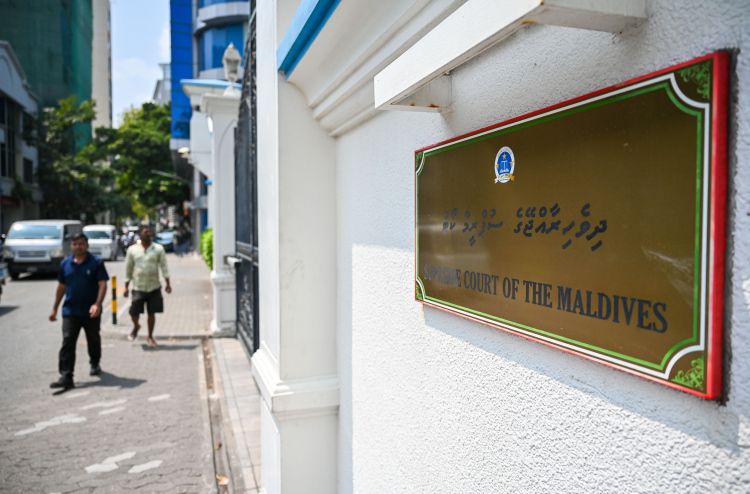
Supreme Court Overturns USD 2 Million Judgment Against State in Centa Enterprises Case
The Supreme Court has overturned a judgment that ordered the state to pay USD two million (MVR 32 million) to Centa Enterprises for medical equipment and consumables said to have been supplied to the state.
Under an agreement made with the state in October 2007, Centa Enterprises filed a case in the Civil Court in 2022 seeking a total of five million dollars, comprising the value of medical supplies said to have been supplied to the Department of Medical Services plus a fine. In 2023, the Civil Court ruled that after deducting the fine, the state should pay the company two million dollars, the value of the invoice. The High Court later upheld that decision when the state appealed.
When the state appealed the High Court judgment to the Supreme Court, Judge Hussain Shaheed, who wrote the opinion of the judgment delivered by the court yesterday, noted that the lower court and the High Court had decided the case without regard to the evidence presented.
The judgment states that no document was submitted to establish that goods were supplied to various islands of the Maldives in accordance with the agreement and that a joint inspection test was conducted. The judge noted that in the "combined delivery note" submitted, the name or designation of the party to whom the goods were handed over and a date are not known, and that there were discrepancies in witness testimony.
According to the judgment, the financial statements submitted by Centa Enterprises to the Economic Ministry for the years 2007, 2008 and 2009 did not state that the state had to pay the company such a large amount of money or that such an expenditure had been incurred.
While the case was proceeding in the Supreme Court, the court treated a special audit report prepared by the Auditor General's Office as new evidence. According to what was revealed in that report, the documents submitted by Centa Enterprises included the name and signature of a party who did not hold a position at the then Department of Medical Services.
The bank guarantee submitted in the case is considered to be a fabricated, inauthentic document, and the judgment also states, with reference to the audit report, that the documents used a project code that had been issued for other work. The judgment noted that in a document from 2007, the name later used was used instead of the name then known as the Tender Evaluation Board.
The judgment also states that even by the date on which the goods are said to have been delivered, the company had not imported into the Maldives any goods of the type stated in the agreement.
Centa Enterprises is seeking more than 400 million in claims filed against the state, said to be seeking the value of services. Looking at the matters noted in the audit report, the Supreme Court judgment noted that they raise major doubts as to whether it was a transaction that actually took place, and also that it is a matter the Auditor General's Office has submitted to the police for a criminal investigation.
Therefore, determining that it is not established by the standard of proof that goods were supplied under the agreement submitted by Centa Enterprises, the Supreme Court has overturned the judgments of the Civil Court and the High Court.
The case was decided by the unanimous agreement of the Supreme Court bench, which was presided over by Judge Shaheed and also included Judge Ali Rasheed Hussain and Judge Dr. Mohamed Ibrahim.