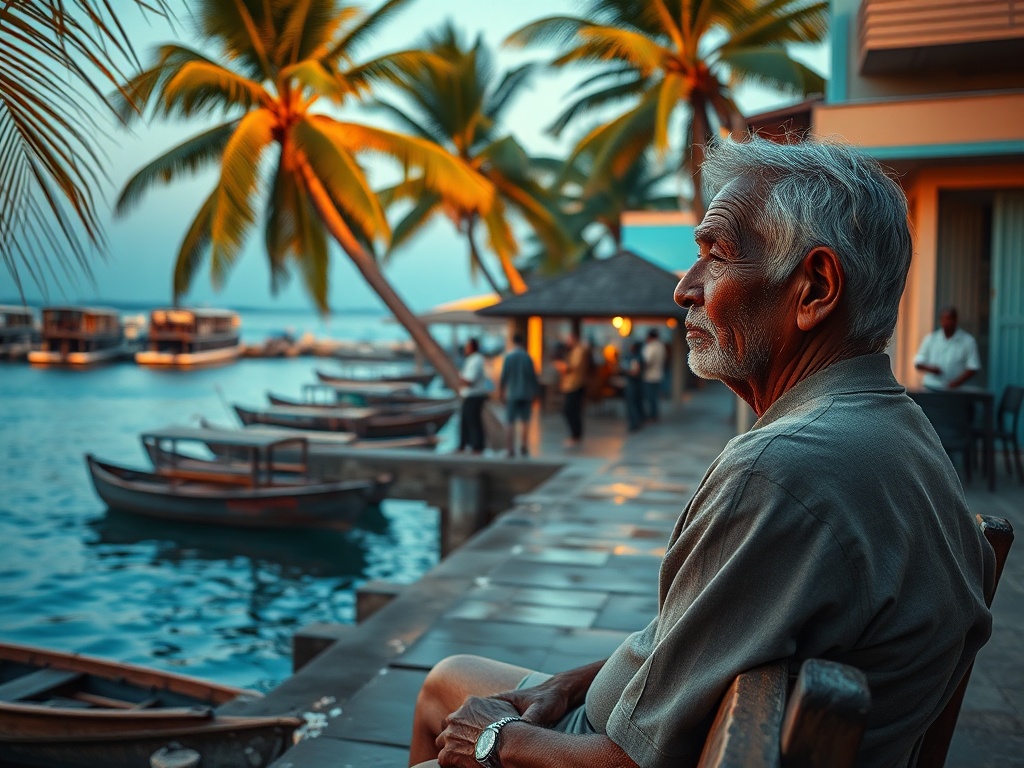
The Bench Where Hassan Watches the Young Men Decide
The evening breeze carried the scent of salt and diesel across the harbor. Hassan sat on his customary bench, the wood worn smooth by years of his presence. His fishing days were behind him, but the sea still called to him in whispers. Tonight, the air felt different—charged with the electricity of political talk drifting from the nearby café.
Young men clustered around plastic tables, their voices rising and falling like the tide. He caught fragments: "...name on the ballot..." "...philosopher king..." "...follow the law..." The words swirled in the humid air, mixing with the clatter of dominoes and the hiss of the espresso machine.
Hassan remembered his father steering their dhoni through monsoon storms, hands steady on the tiller, reading the water like scripture. "A good captain doesn't fight the sea," he'd say. "He understands its rhythm." Now, listening to these young men debate what made a good leader, Hassan wondered if anyone still understood the rhythm of these islands.
He watched a group of boys kicking a worn football on the sand court, their shadows stretching long in the golden light. One boy, particularly skilled, dribbled past his friends with effortless grace. Hassan saw in him the same focus his father had possessed—that intuitive understanding of movement and balance.
The café television flickered with news of distant elections, foreign first ladies, and defunded police. Hassan sipped his sweet tea, the glass warm in his hands. These concepts felt as distant as the constellations beginning to prick the darkening sky. Here, the real questions were simpler, more fundamental: Would the fishing cooperative get its new ice machine? Would the school roof hold through the next rainy season? Would his grandson find work that didn't require leaving the atoll?
A gecko chirped from the wall beside him. Hassan smiled, remembering how his wife used to say the house geckos brought good luck. She'd been gone five years now, but her wisdom lingered in the small moments. "Too many ministers," she'd once remarked, watching a political rally on TV. "Like having ten captains for one boat."
The young men's debate turned to salaries—whether leaders should take them or not. Hassan thought of the shared catch from community fishing trips, how everyone received their fair portion regardless of who steered the boat. The system worked because everyone understood their role, their responsibility to the whole.
As full darkness settled and the stars emerged in brilliant clarity, Hassan rose slowly, his joints complaining. The political arguments would continue, he knew—the names on ballots would change, the slogans would evolve. But the sea would still sigh against the shore, the palms would still rustle in the wind, and people would still need leaders who understood the rhythm of these fragile islands in a changing world.
— Source fragments: Fragments about leadership philosophy, ballot candidacy, and governance discussions inspired the thematic exploration, though specific political references were excluded