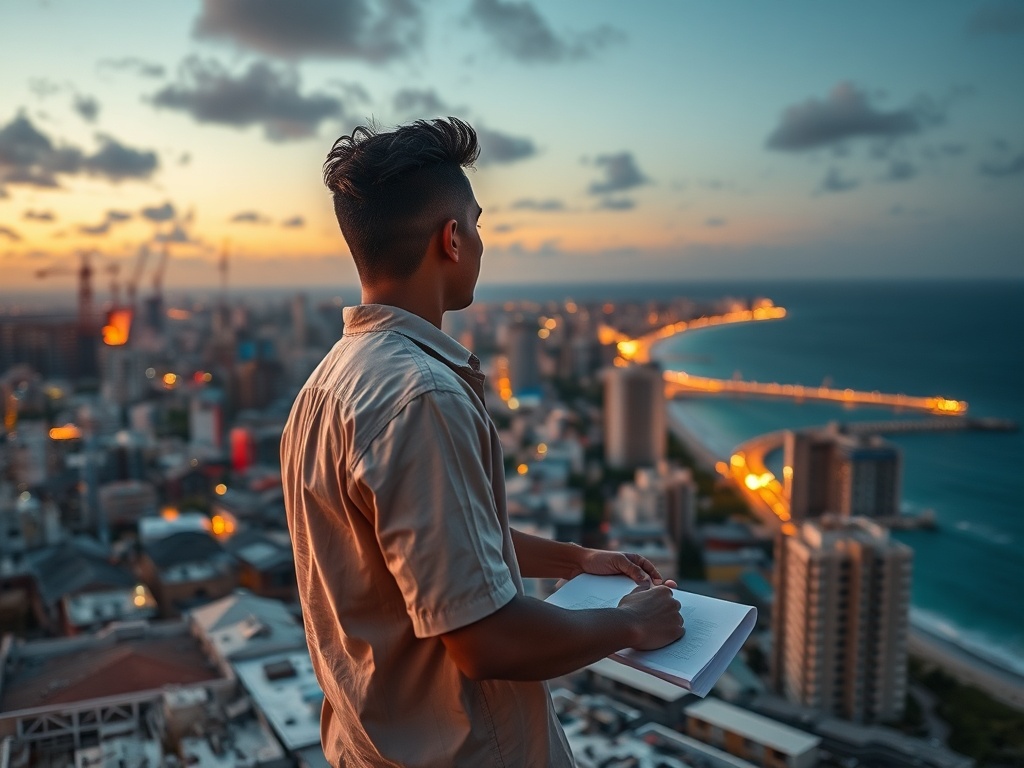
The blueprint in his hands, the political connections he doesn't have
The humidity hit Hassan like a physical wall as he stepped from the air-conditioned airport terminal. After five years studying civil engineering in Malaysia, Malé felt both familiar and foreign. The scent of salt and diesel hung heavy in the air, mingling with the distant promise of rain.
His degree felt like a heavy stone in his pocket as he watched the cityscape—a jumble of concrete towers reaching desperately for sky between narrow streets. He remembered his professor's words: 'Infrastructure is the skeleton of civilization.' But here, Hassan suspected, the bones were built on shifting sands.
He'd come home with dreams of designing sustainable housing, of creating systems that could withstand rising seas. But his first job interview had been with a ministry official who spent more time asking about his family connections than his thesis on coastal reinforcement. The man's office had been opulent, air-conditioned to Arctic levels, while outside the window Hassan could see laundry strung between crowded apartment blocks.
Walking through the narrow streets of Malé felt like navigating the arteries of a body under stress. Everywhere he looked, construction cranes stood like metal herons fishing in concrete waters. New buildings rose where old neighborhoods once stood, their glass facades reflecting the desperate ambition of a city running out of space.
At the local coffee shop, he met his childhood friend Aminath. Her engineering degree gathered dust while she worked as a receptionist. 'They hired the minister's nephew,' she said, stirring her tea without looking at him. 'He failed three subjects in first year, but he knows how to smile at the right people.'
That evening, Hassan stood on his family's rooftop, watching the sun bleed into the Indian Ocean. The lights of the tourist resorts twinkled in the distance like false promises. He thought of the sustainable designs in his portfolio, the careful calculations, the models that accounted for sea level rise. Then he looked at the haphazard construction around him—buildings thrown up quickly, their foundations questionable, their futures uncertain.
The gap between what he'd learned and what was being built felt like an ocean he couldn't cross. His education had taught him how to calculate load-bearing capacity, but nothing had prepared him for the weight of political connections. He'd studied materials science, but no textbook explained the strange alchemy that turned public funds into private assets.
As darkness settled over the city, Hassan made a decision. He would stay. Not because he believed he could change the system overnight, but because someone needed to remember what proper engineering looked like. Someone needed to keep the blueprints of better buildings, even if they remained just lines on paper for now.
The sea breeze carried the scent of coming rain, and Hassan breathed it in like a promise. However crooked the paths to construction might be, the foundations he would build would be straight and true. That would have to be enough for now.
— Source fragments: Civil engineering education, political appointments, housing crisis, youth unemployment, infrastructure development challenges