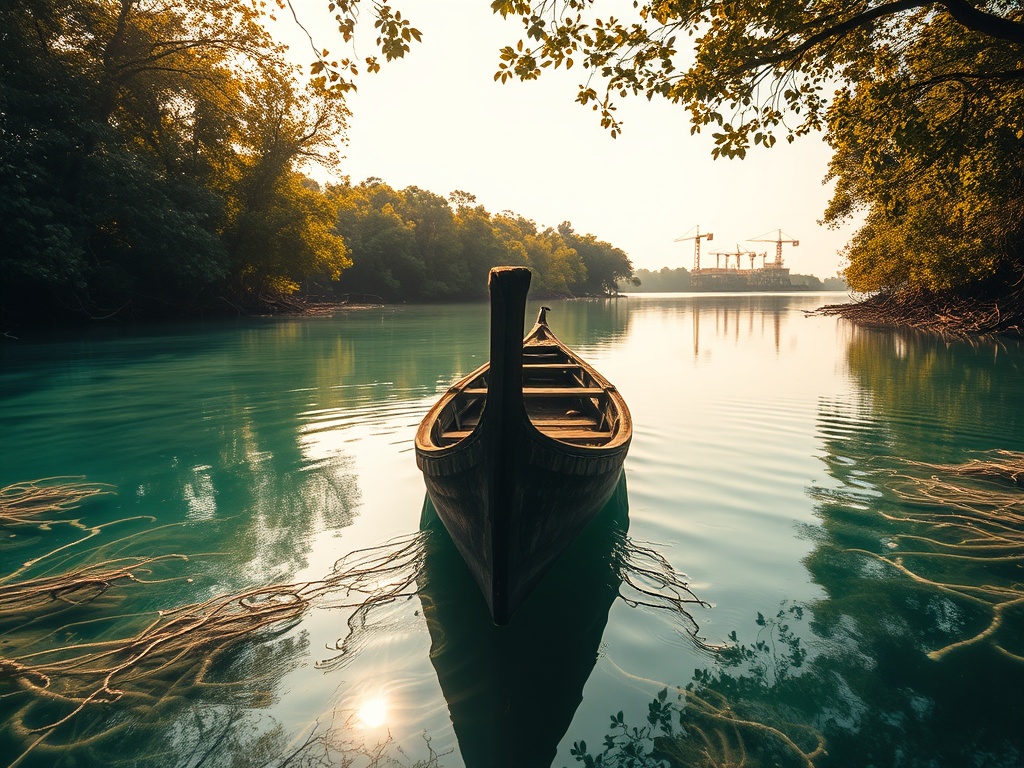
The Canoe's Last Journey Through Fishimathi's Shrinking Mangroves
The canoe glides through water the color of steeped tea, beneath a canopy so dense it filters the equatorial sun into dappled gold. This is the Fishimathi mangrove in Addu's Hithadhoo, a living labyrinth of breathing roots and breeding grounds. But today, the journey from Baravela Muli to Moolekede Fishimathi carries the weight of farewell.
Across the archipelago, the sound of bulldozers has become as familiar as the call to prayer. In Fuvahmulah, ancient coconut palms fall to make way for roads that mimic Malé's concrete grid. In Addu, mangroves that have nurtured fish, crabs, and shrimp for generations are being cleared for infrastructure projects that critics call short-sighted. The justification often centers on modernization—what many islanders call 'tharahghee'—but the trade-off is stark: natural protection systems that took centuries to establish are vanishing within weeks.
These ecosystems represent more than biodiversity; they are the archipelago's first line of defense against storm surges and rising seas. Each mangrove root system lost means diminished fisheries and increased vulnerability. The debate has shifted from whether development is needed to what kind of development sustains both people and place. Policy discussions now center on whether existing routes could be upgraded rather than new ones carved through vital habitats.
The tension reflects a deeper conflict in the Maldivian psyche—between the allure of urban convenience and the wisdom of traditional coexistence with nature. As one mangrove falls, then another, the cumulative impact becomes undeniable. These are not vacant lands awaiting purpose but functioning ecosystems that support both marine life and human communities.
Protest petitions gather signatures, NGOs raise concerns, and local voices oppose the destruction, yet the projects advance. The framing of reclamation as innovative industry clashes with the visible reality of centuries-old habitats being cleared for temporary economic gain. What emerges is a portrait of a nation grappling with its identity at a climatic precipice, where the very features that define the Maldives—its intricate relationship between land and sea—are being systematically dismantled.
From the canoe, the water tells the full story. Where mangrove roots once filtered nutrients and sheltered juvenile fish, soon there will be compacted soil and asphalt. The journey ends not just at Moolekede Fishimathi but at a question: when the natural defenses are gone, what will remain to buffer these islands from the rising tides?
— Source fragments: Canoeing from #BaravelaMuli to #MoolekedeFishimathi, Probably my last time in fishimathi, EPA approved to destroy our mangroves, Addu's Hithadhoo Fishimathi mangrove is not vacant land, It's a living nursery for fish, crabs and shrimp, Reclaiming that mangrove for a new road when an existing route can be upgraded, Every mangrove we lose reduces storm protection, fisheries, Fuvahmulah cutting down coconut palms, Most islanders want 'tharahghee' meaning concrete structures like Male' City