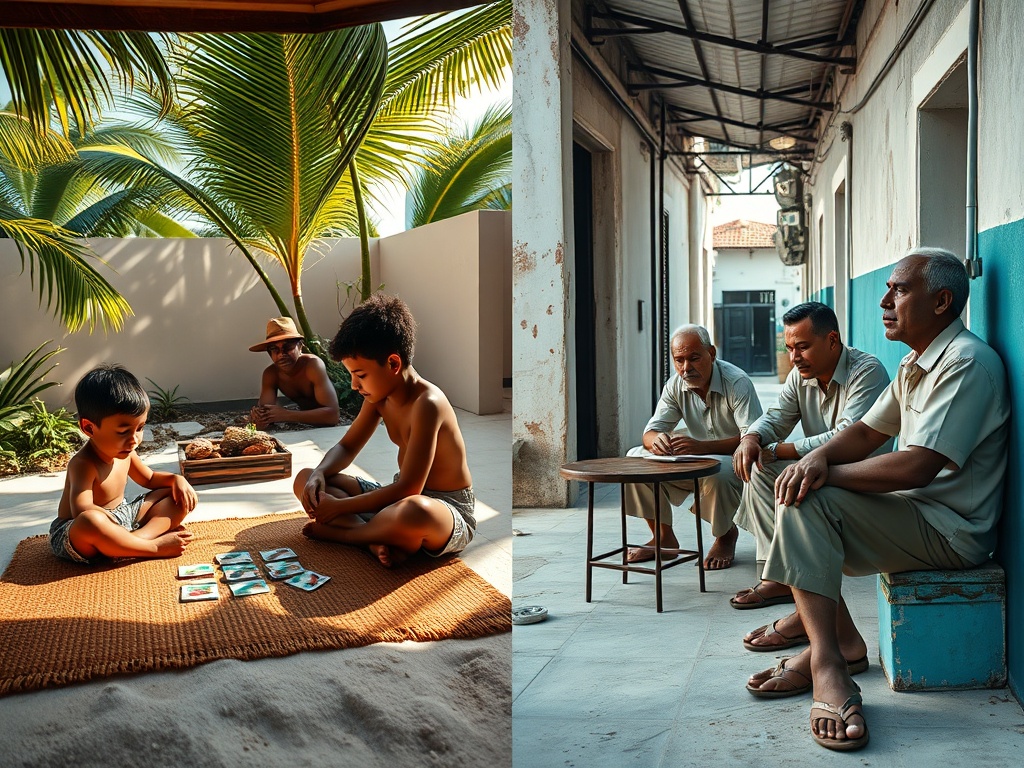
The Card Game That Turned Into a Café Argument
There comes a point in every debate, every argument, every late-night social media scroll when the exhaustion sets in. That weary recognition that you've been at this for what feels like forever—a year, a month, or just one particularly draining evening—and the conversation has gone nowhere meaningful. This fatigue isn't just about time spent; it's the soul-deep weariness of engaging in conversations that fundamentally misunderstand their own purpose.
The childhood game of matching pictures—spotting similarities and differences between apparently similar objects—has become our default mode of discourse. We line up political ideologies, social policies, and personal choices like apples and oranges, convinced that if we just examine them closely enough, we'll find some universal truth. But as any child who's played the game knows, sometimes the differences are so fundamental that the comparison itself becomes what one observer called 'futile work.' The exercise reveals nothing beyond the initial observation that these are, in fact, different things requiring different handling.
This recognition often arrives with the jarring interruption of ordinary life—being pulled from sleep, distracted from work, or suddenly realizing you've lost track of basic necessities. The mundane details of existence—where you left your fork, the comfort of a full night's sleep, the strange disconnect between someone's online persona and their real self—become anchors in a sea of abstract arguments that have lost their connection to lived experience.
In the Maldives, where political debates often revolve around complex foreign relations, economic policies, and governance structures, this pattern plays out daily. Citizens find themselves comparing development models, political leaders, and economic strategies that may share superficial similarities but operate on fundamentally different principles and contexts. The result is often exhaustion rather than enlightenment.
The solution isn't to stop comparing altogether—comparison is how we make sense of the world—but to recognize when we're comparing things that cannot be meaningfully measured against each other. When the exercise becomes more about performing analysis than achieving understanding, when it disrupts our basic human needs and connections, it's time to step back. Sometimes the most productive response to an intractable debate is simply to acknowledge its futility and redirect that energy toward something tangible—a genuine connection, a practical solution, or even just a good night's sleep.
— Source fragments: Nah, that went on for a year... Ugh!!; Genuine question, did you ever play match the common pictures as a child? Or even general matching games that encourage you to spot the differences and common factors? You are comparing an orange and an apple - it's futile work.; Excuse me where the hell are you fork.; i was fast asleep and got woken up in my oven; God forbid a man enjoys his 8 hours