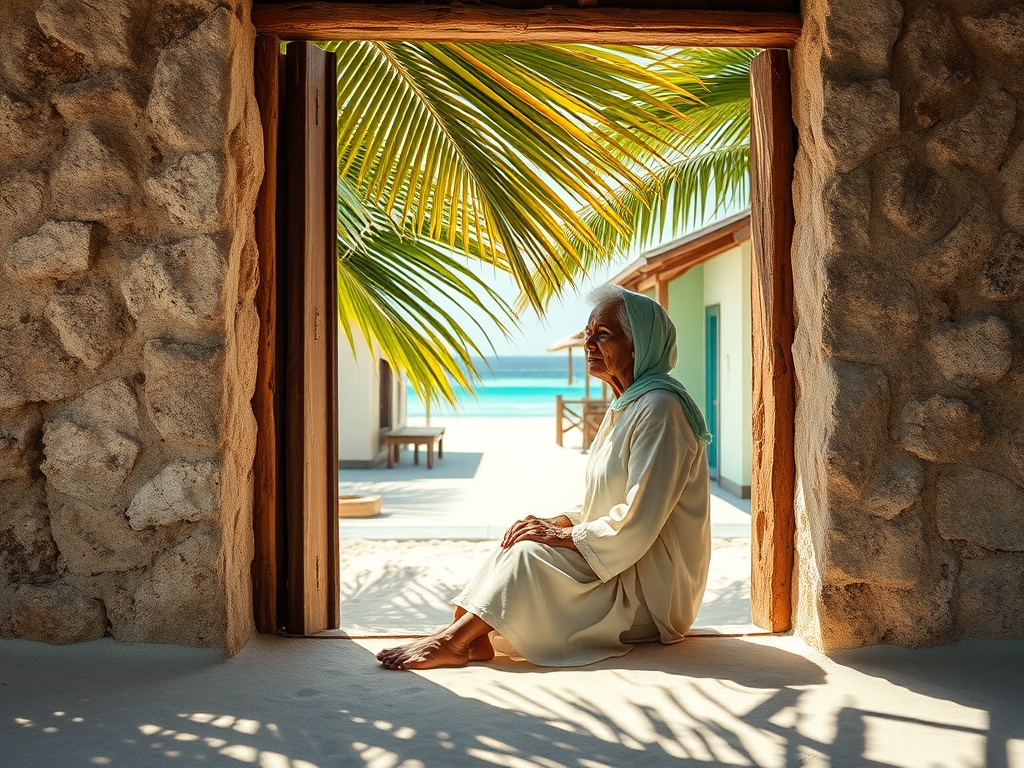
The Eight-Year-Old Who Fell In and Came Out White-Haired
I remember her as an elderly woman with hair like fresh coconut flesh—pure, stark white against the warm Maldivian sun. As children, we knew the story whispered between households: when she was eight years old, she had fallen into a well and remained trapped there for days before being discovered. The trauma of that experience, the darkness and isolation, had turned her hair white overnight. It never regained its original color.
This transformation fascinated me then as a child, and it haunts me now as an adult. How does fear become so powerful that it rewrites our very appearance? In a nation of islands surrounded by endless ocean, where water represents both life and potential danger, her story takes on additional resonance. We live with water constantly—it defines our geography, our economy, our daily existence—yet contained water, like that in a well, can become something entirely different.
Her white hair became a permanent public record of a private terror. Every time she stepped outside her home, the evidence of that childhood trauma walked with her. There was no hiding it, no covering it up with dyes or headscarves in the way one might conceal other scars. The community knew, and in knowing, collectively bore witness to her suffering.
This phenomenon—where psychological distress manifests physically—speaks to the deep connection between mind and body that modern medicine is only beginning to fully understand. In our culture, where mental health conversations are often kept behind closed doors, such visible markers of trauma force us to acknowledge what we might otherwise ignore.
Today, walking through the narrow streets of Malé, I see other kinds of trauma written on faces—the economic anxiety of parents wondering how they'll afford another price increase, the weariness of young people seeing limited opportunities ahead, the tension of a society navigating complex political currents. These aren't as immediately visible as white hair, but they're just as real, just as transformative.
Her story reminds me that trauma changes us, marks us, but doesn't necessarily break us. She lived a full life despite that childhood accident. The white hair wasn't a sign of weakness but of survival—a badge of having endured something terrifying and emerging, fundamentally altered but still here.
In our rapidly changing nation, where traditional ways collide with modernization pressures, we carry both collective and individual traumas. Some are visible, like white hair; others hide beneath the surface, waiting for the right conditions to emerge. Recognizing them, in ourselves and each other, might be the first step toward healing.
— Source fragments: Trauma. As a child we had a lovely lady living a few doors away. Pure white hair. She fell into a well at the age of 8. Trapped and undiscovered for days. When she was found her hair had turned white. It never regained its colour!