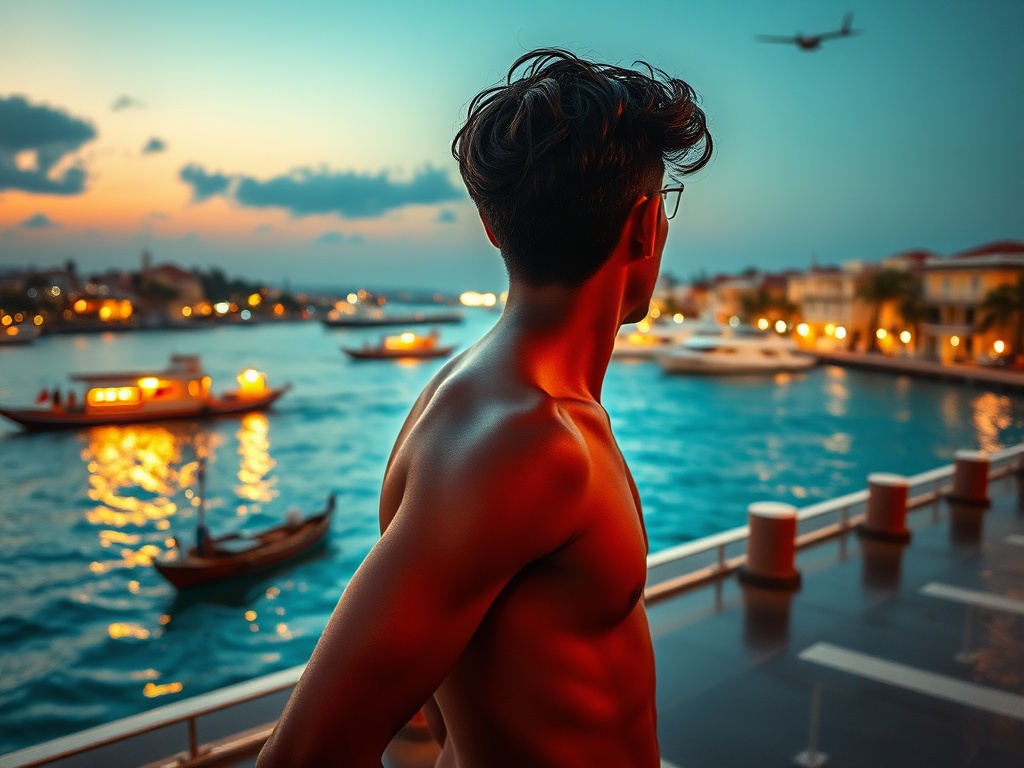
The Ferry Horn That Tightens His Chest
The ferry horn echoed across the channel, a sound that always made Ismail's chest tighten. He stood on the Malé waterfront, watching the inter-island ferry being loaded with crates of vegetables and families returning home. The salt spray mixed with diesel fumes created a familiar scent that clung to his clothes—the smell of being caught between two worlds.
He remembered his grandmother's stories of their island, where the coconut palms bent toward the sea as if bowing to the horizon. She'd described a life where everyone knew the rhythm of the tides, where the call to prayer wasn't drowned out by traffic, where the night sky wasn't bleached by city lights. 'We are people of the sea,' she'd say, her hands tracing patterns in the air. 'Not people of concrete.'
Yet here he was, in this city of concrete, where buildings climbed over each other like anxious children trying to see the ocean. He'd come for university, for opportunity, for a future that seemed to be shrinking back on his island. But in Malé, he discovered another kind of tide—the subtle undercurrent of being 'from the islands.' The way people's eyes would flicker when he mentioned his home atoll, the unspoken hierarchy that placed certain dialects above others.
His phone buzzed with a message from his cousin back home: 'Any news about the housing application?' Ismail sighed. He'd been waiting six months, caught in the bureaucratic currents that seemed to flow differently for different people. He'd heard the whispers—'Malé people get priority,' 'islanders don't understand how things work here.'
Sometimes, late at night, he'd walk to the artificial beach and watch the waves break against the seawall. The ocean didn't care where you were from—it treated all land with the same relentless patience. He thought about the generations before him, the fishermen who navigated by stars, the women who woven mats from palm leaves, the children who learned to swim before they could walk.
Now his generation was learning to navigate different waters—the crowded streets of Malé, the complex social currents, the politics of belonging. They were the 'baakee generation,' as someone had called them—leftover, surplus, floating between identities.
But as he watched the ferry pull away, its wake spreading across the dark water, Ismail realized something. The ocean that separated the islands also connected them. The same water that lapped against his home island's shore touched this concrete coastline. The division was human-made, temporary as a line drawn in wet sand.
He took a deep breath, the salt air filling his lungs. He was neither entirely of the islands nor of the city. He was Maldivian, and that meant carrying both waters within him—the deep blue of the atolls and the reflected light of the capital. And perhaps that was enough.
— Source fragments: We are the baakee generation. No opportunity in the islands because we moved to Malé. And no opportunity in Malé because we were born in the islands; Can we address and acknowledge the trauma forced upon raajjetherey meehaa by the central government; The Malé person should have the same rights as the RT person. Thafaathu kurun is the problem; Malé supremacy will ruin rest of Maldives