The Ferry Ride Where Malé's Shadows Reach Your Home Island
The ferry rocked gently as it approached Malé's harbor, the city rising like a concrete reef from the ocean. Ahmed watched the familiar skyline, remembering his grandfather's stories of when these buildings were just dreams sketched on paper. Now they cast long shadows that reached all the way to his home island in Laamu Atoll.
He'd come to the capital for what they called a 'housing opportunity meeting.' The room was filled with faces from across the archipelago, but the air carried an unspoken hierarchy. The man next to him, born and raised in Malé, spoke of land rights as inheritance. "My family has been here for generations," he said, as if time alone could claim ownership of coral and sand.
Ahmed thought of the falhu near his home island—the shallow lagoons where children learned to swim, where fishermen rested between journeys. Now he heard people speaking of these places as real estate, as political currency. Someone at the meeting joked about wanting a floating home near Malé, claiming it as their birthright. The laughter felt like saltwater on a fresh wound.
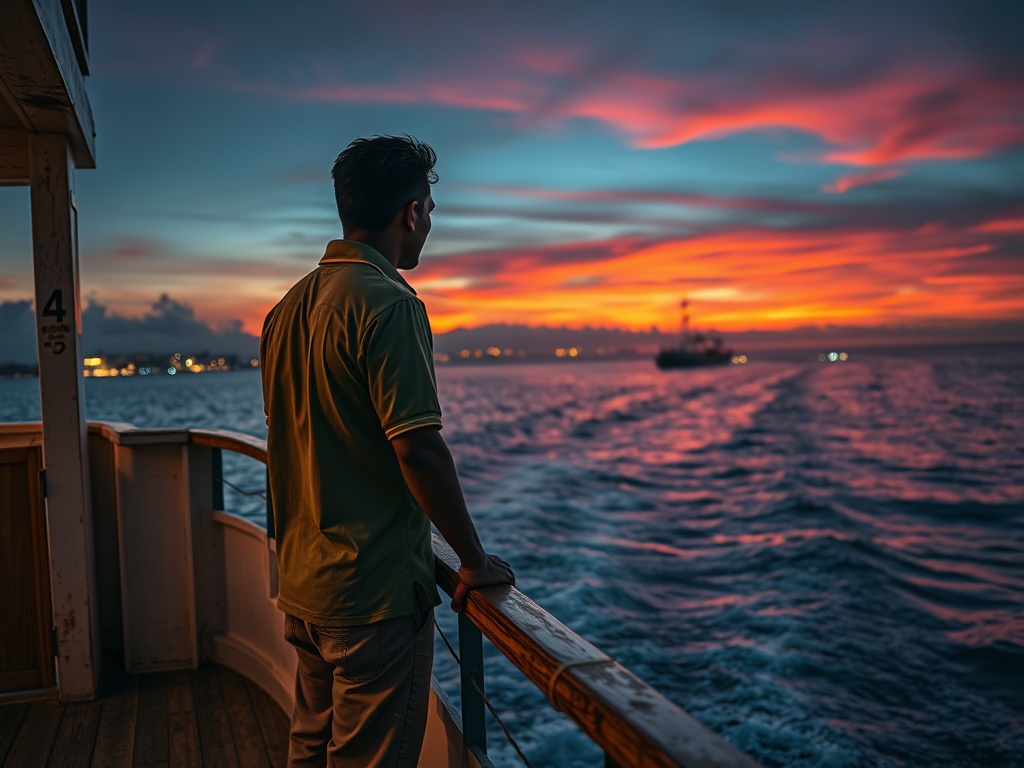
Later, walking along the seawall, Ahmed watched the sunset paint the Indian Ocean in shades of orange and violet. The same water that lapped against Malé's reinforced shores also caressed the untouched beaches of Laamu. How had the sea become a boundary instead of a connector? How had people from the same nation, praying to the same God, speaking the same language, become divided by something as arbitrary as which island they were born on?
He remembered his father's words: "The ocean doesn't discriminate between atolls. The currents flow where they will, and the fish swim where they please." Yet here they were, drawing lines in water, creating hierarchies where none existed in nature.
The housing official had used the term 'vazanveriya'—native of an island—as if it were a category in a ledger. But Ahmed knew being from Laamu wasn't just paperwork. It was knowing which monsoon winds would bring the best fishing, which coral formations sheltered the brightest parrotfish, which beaches held the smoothest sand for children's games.
As night fell and the city lights reflected on the dark water, Ahmed realized the true division wasn't between Malé and the atolls, but between those who saw the islands as property and those who understood them as home. The same policy documents that promised equality somehow always found ways to measure people's worth by geography rather than humanity.
He boarded the last ferry back to Laamu, watching Malé shrink into a constellation of lights on the horizon. The ocean stretched between them, vast and indifferent to the small dramas of humans. Somewhere in the dark water, Ahmed knew, the dividing lines they'd drawn on maps were being erased by the eternal rhythm of the tides.
— Source fragments: Malé supremacy will ruin rest of Maldives; Malé people deserve good housing but; The Malé person should have the same rights as the RT person; You cannot be discriminated against as a vazanveriya of Laamu atoll; Why is there special treatment for you?; discriminatory policy; belongs to elite Malé