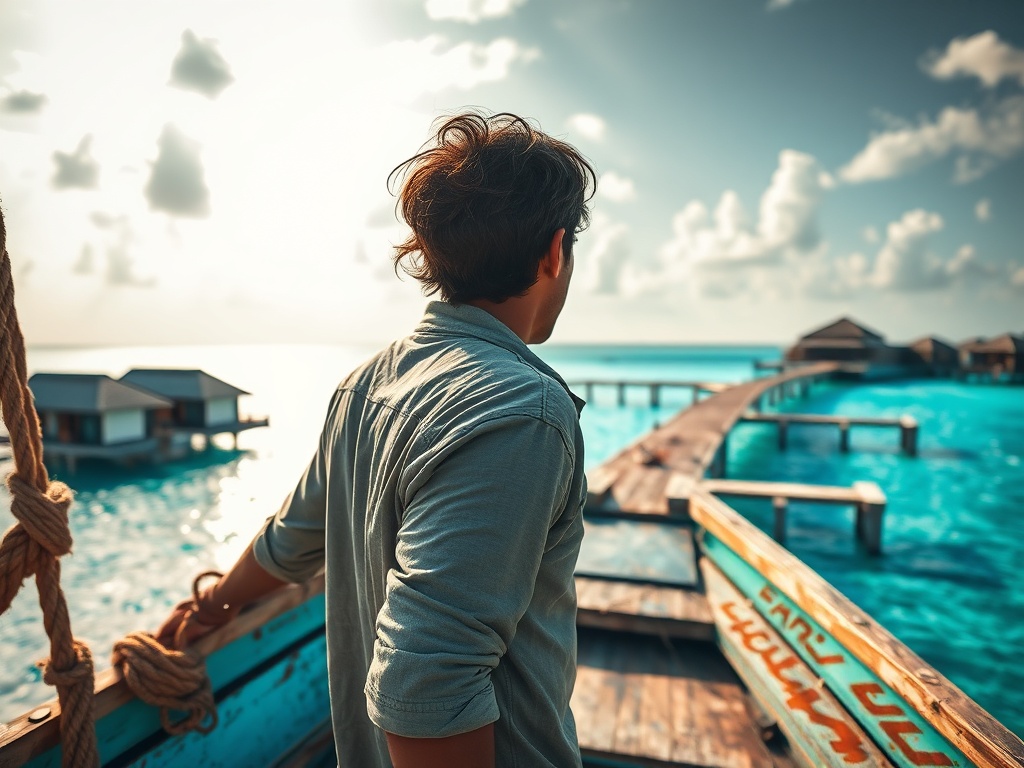
The Fisherman Watching the Resort from His Dhoni
The conversation about Maldives' economic future often centers on a false dichotomy: either we preserve tourism as our sole economic pillar, or we dismantle it to make room for diversification. But this framing misses the nuanced reality that many Maldivians understand intuitively—tourism isn't the enemy of economic evolution; it's the foundation upon which we can build a more resilient future.
With a population of just over 400,000 and a workforce of approximately 100,000 supporting the entire nation, the mathematics of prosperity become starkly clear. A $5 billion economy should theoretically translate to decent livelihoods for all, yet the disconnect between national wealth and individual financial security remains palpable. The challenge isn't merely about generating revenue but ensuring it circulates within our communities rather than draining abroad through expatriate remittances or offshore accounts.
The housing dilemma illustrates this perfectly. When a Malé resident receives land in Hulhumalé only to rent it out while living abroad, the economic benefit leaks out of our system. This isn't fundamentally about land ownership but about money flows—who captures value from our limited resources. The same principle applies to tourism: when resort profits are parked overseas rather than reinvested locally, the economic safety net develops holes.
Yet calls to 'destroy tourism' to force diversification misunderstand both economics and risk management. Tourism provides the stable platform from which we can experiment with new industries. It funds government services, employs thousands, and brings foreign currency into our economy. The question isn't whether to diversify but how to do so intelligently—identifying the 'exact ratios' of investment across sectors that one observer wondered about.
This requires elevating our tourism policies beyond mere visitor numbers to creating genuine value retention mechanisms. We need to transform tourism from an extractive industry to a regenerative one—where more profits stay within Maldivian hands, where local talent develops management and ownership capabilities, and where the industry fuels rather than hinders other sectors.
The real conversation we should be having centers on wealth creation versus distribution. As one voice noted, 'wealth should be made, not distributed for free.' This speaks to the need for an entrepreneurial mindset shift—from seeing ourselves as recipients of government benefits to creators of economic value. Whether through high-tech agriculture, marine biotechnology, or digital services, diversification should build on our unique advantages rather than rejecting our successful foundation.
Our high standard of living compared to regional neighbors—with minimal slums and homelessness—testifies to tourism's transformative power. Yet the high cost of living reminds us that economic success has its own challenges. The path forward requires neither destroying our golden goose nor worshipping it uncritically, but rather evolving it into something more sustainable, more equitable, and more Maldivian.
— Source fragments: Can we diversify Maldives economy by destroying Maldives tourism?; tourism is the safety net while we take risks to diversify our economy; I like to believe govt will know that exact ratios to spend on each sector; 400k population with about 100k work force which feeds the rest; Can’t there be a way that this 100k is paid well with a 5billion USD economy; The issue revolves around money. If Male' man has no place and rents a place to live in Hulhumale' he is spending money on rent; wealth should be made. not distributed for free; We dont have any slums and barely any homeless on the streets compared to thousands in those countries; We are fortunate but we cant enjoy it coz cost of living is also high