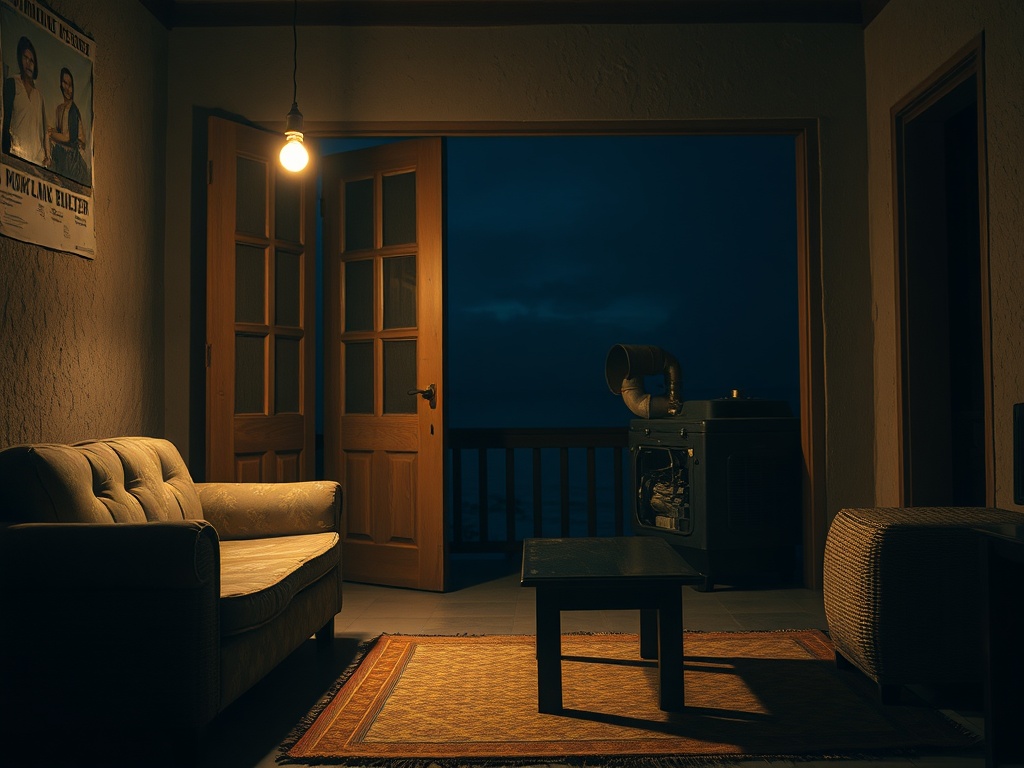
The Generator That Stole a Family's Breath
The generator hummed in the next room, a mechanical heartbeat that should have signaled security but instead marked tragedy. This simple household appliance, meant to provide backup power during outages, became the silent witness to a family's demise. Across our islands, similar stories unfold—not always with such devastating finality, but with the same underlying theme: our systems, both domestic and societal, contain hidden failures that emerge when we least expect them.
In the capital's congested neighborhoods, where housing shortages force families into cramped quarters, the placement of essential equipment becomes a matter of life and death. The generator that should be safely distant from living spaces ends up in adjacent rooms, separated by thin walls that cannot contain carbon monoxide or other hazards. This physical proximity mirrors our societal vulnerabilities—how economic pressures and inadequate infrastructure create conditions where safety becomes secondary to necessity.
The disappearance of once-familiar products from shop shelves tells another story of systemic breakdown. When essential items vanish from local markets, it reflects deeper supply chain issues and foreign currency shortages that plague our import-dependent economy. What we mourn isn't just the absence of a particular product, but the loss of reliability in our daily lives. The emotional response to these disappearances—the genuine distress—speaks to how deeply these failures affect our sense of normalcy and security.
Meanwhile, the language of competition and judgment permeates our discourse, whether in traffic or in life. The critique of taking a corner "way too wide when you should've been tighter" becomes metaphor for the precision required to navigate our complex social landscape. In a society where opportunities are limited and the margin for error is slim, every decision carries weight. The pressure to perform perfectly, to stay within narrow boundaries, creates constant tension.
This extends to our collective disappointments—the talented individuals who never get their chance, the voting systems that limit our choices, the sense that potential goes unrealized due to structural constraints. When we lament that "they should have let us vote for more than one person," we're expressing frustration with systems that restrict agency and possibility. The desire for broader participation reflects our understanding that complex problems require multifaceted solutions.
These individual experiences—the tragic, the frustrating, the disappointing—connect to form a pattern of systemic vulnerability. They remind us that safety, reliability, and opportunity cannot be taken for granted, and that the mechanisms meant to protect us sometimes become the sources of our greatest risks. As we navigate these challenges, the question becomes not just how to fix individual failures, but how to build systems resilient enough to prevent them.
— Source fragments: This is about the death of a family. The generator was in next room; I remember this, don't see it in the shops anymore; it's a chicane and you went way too wide when you should've been tighter; a person is in a bad situation, has been tricked, or has experienced a failure or defeat; I really wanted him to debut too like why couldn't they have let us vote for more than one person