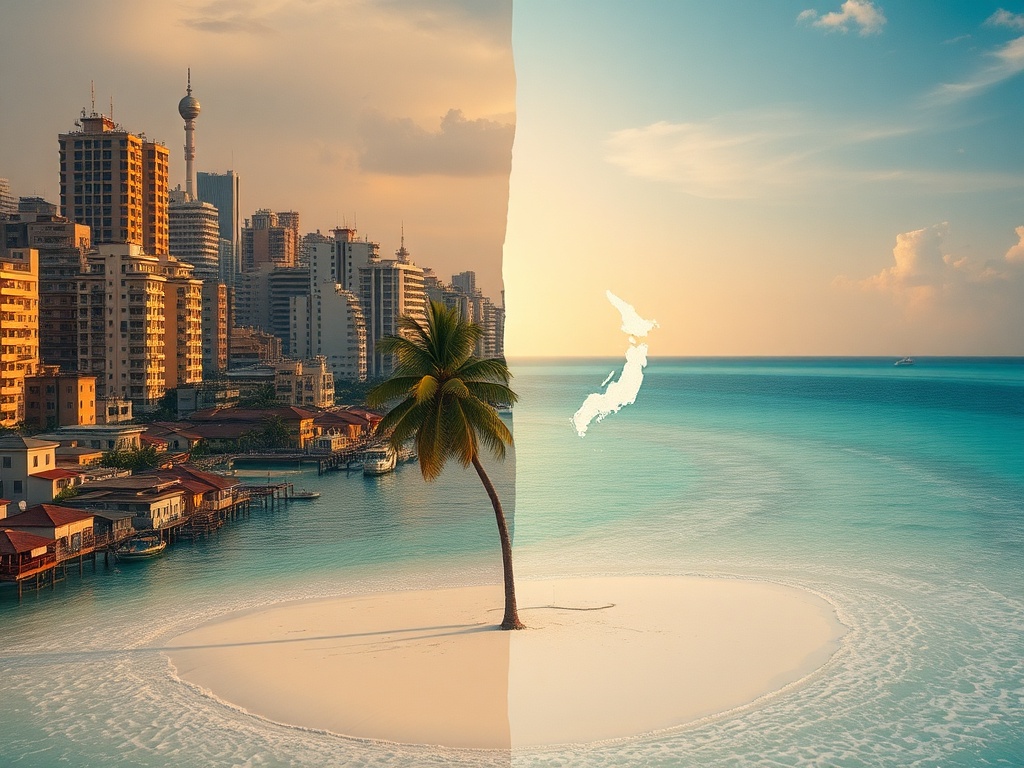
The Maldives' Two Skylines: Malé's Towers, the Atolls' Palms
The debate over land distribution in the Greater Malé Region has become a mirror reflecting the Maldives' deepest social divides. What began as a policy discussion about housing has escalated into a raw examination of identity, historical grievance, and competing visions of national belonging.
At the heart of the conflict lies a fundamental tension: the perception that Malé, as the nation's capital and economic engine built on the national budget, holds a position of supremacy over the outer atolls. Critics argue that granting free land plots exclusively to Malé residents perpetuates a system where the center benefits at the periphery's expense. They contend that high-value urban land should serve the nation's collective future, not reinforce geographic privilege.
This policy has unearthed generations of accumulated resentment. Many from the atolls speak of a persistent trauma—the feeling of being systematically marginalized by the central government since the nation's founding. They describe being caught in a double bind: 'We are the baakee generation,' as one sentiment captures it, with no opportunity in the islands that forced migration to Malé, yet facing discrimination in the capital for their island origins.
The counter-argument emerges with equal force from Malé residents who feel unfairly characterized. They question why identical living conditions in the capital should yield different rights, asking why some are granted land while others are disqualified nationwide based solely on their geographic designation. The frustration is palpable among those who see themselves labeled as 'vampires' or 'supremacists' despite sharing the same economic struggles as their atoll-born neighbors.
Beneath the surface of this geographic dispute lies the real culprit: systemic discrimination, or 'thafaathu kurun' as it's commonly known. The problem isn't that Malé residents deserve housing, but that allocation systems create hierarchies of citizenship. The debate has shifted from simple resource distribution to questioning the very mechanisms that sort Maldivians into categories of deserving and undeserving.
The conversation reveals how land has become the currency of political patronage, with accusations that housing policies serve electoral strategies rather than national unity. This politicization of basic needs has created a dangerous polarization, with some warning that the tolerance of previous generations may not extend to the next.
As the Maldives grapples with its identity in the 21st century, the land debate forces a difficult conversation about equity, history, and shared destiny. The challenge is to build a system that acknowledges historical grievances while moving beyond geographic determinism—creating a nation where a person's opportunities aren't dictated by whether they're from Malé or an outer atoll, but by their shared status as Maldivian citizens facing common challenges in an increasingly complex world.
— Source fragments: Malé people don't deserve Free land; Malé supremacy will ruin rest of Maldives; We are the baakee generation; The Malé person should have the same rights as the RT person; Thafaathu kurun is the problem; I see this as a separate issue because what I'm highlighting here is the problem of discrimination; Can we address and acknowledge the trauma forced upon raajjetherey meehaa; Our generation have been tolerant and patient. The next one won't