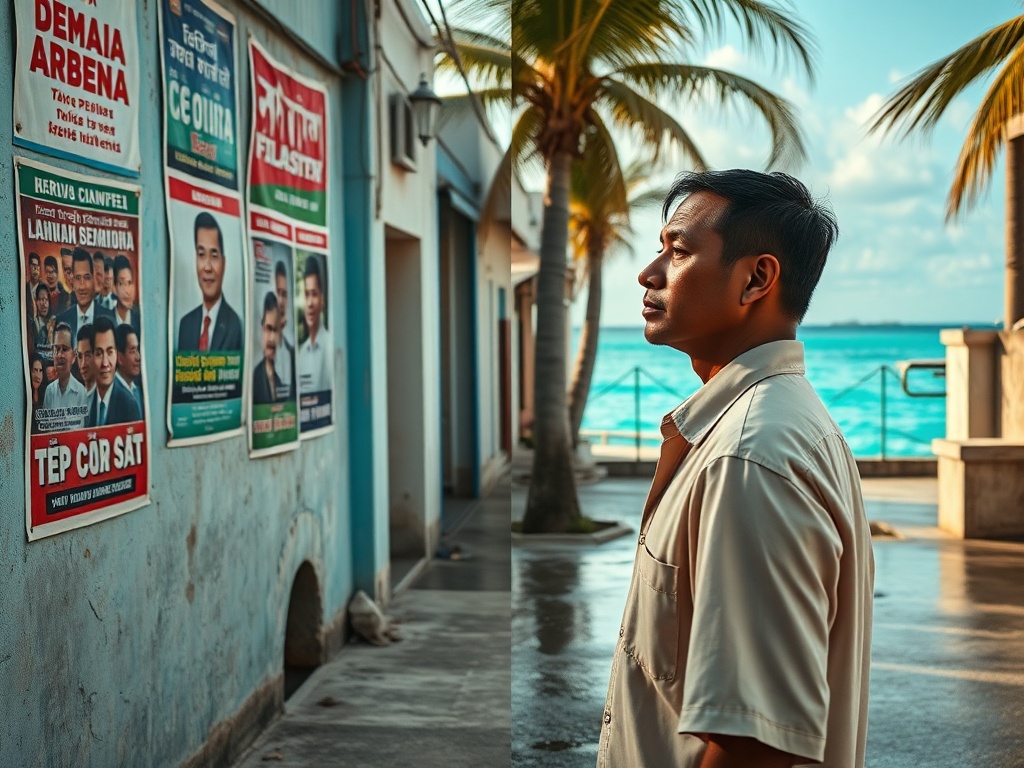
The Maldivian Voter Looking Past Party Banners to the Sea
In the swirling currents of Maldivian politics, where party loyalty often trumps policy substance, a quiet but persistent question emerges: what does it mean to occupy the center? The political landscape has become so polarized that even identifying as centrist feels like a radical act, requiring constant justification in a system that demands clear allegiance.
The conversation playing out across social media platforms and private gatherings reveals a nation wrestling with its political identity. Voices emerge questioning whether socialist ideals—land distribution, universal basic income, employment guarantees—can find footing in a society where such proposals are immediately weaponized for political gain rather than evaluated on merit. The very language of economic justice becomes suspect when uttered outside established party narratives.
This ideological confusion reflects a deeper crisis of political representation. With 76 lawmakers representing island communities versus 17 from Malé, the geographic distribution of power creates inherent tensions in policy priorities. Yet constituents increasingly question whether their representatives advocate for local needs or party directives. The call to 'text your MP' represents more than grassroots mobilization—it's a plea for accountability in a system where the distance between citizen and policymaker seems to grow daily.
The divide between online activism and offline reality presents another challenge. Political parties have become adept at reading these separate currents, recognizing that vocal digital communities don't always translate to electoral majorities. This awareness shapes campaign strategies and policy positions, creating a political calculus that often prioritizes perceived silent majorities over engaged minorities.
At the heart of these discussions lies the fundamental question of how to address issues that 'the country will always be divided on.' The search for 'other solutions' beyond partisan gridlock represents a growing recognition that some challenges require consensus-building rather than political point-scoring. This is particularly true for economic policies that affect citizens regardless of party affiliation—the high cost of living, employment opportunities, and equitable resource distribution.
What emerges is not a coherent centrist movement but rather a collection of individuals thinking beyond party binaries. They're not defined by what they're against but by what they're for—pragmatic solutions, accountable governance, and policies that serve public rather than partisan interests. In a political environment where condemnation of one's own party's missteps remains rare, this willingness to hold all sides accountable represents a quiet revolution in political discourse.
The Maldivian political center, it turns out, isn't a fixed point but a space for negotiation—between tradition and progress, between collective responsibility and individual rights, between the urgent needs of today and the sustainable development of tomorrow. As the nation approaches another electoral cycle, this unresolved tension between polarized politics and pragmatic governance may well determine the country's direction for years to come.
— Source fragments: Good that you realized you have crossed the line between policy and persons; Anyone up for a protest Or do we have RT MPs on our side to advocate; I’m simply asking what your alternative is; They are counting on the off line critical mass. The online crowd is vocal online. it doesn't correlate with offline reality; I don't call myself a socialist but I have been tweeting about giving away land, giving ubi, giving job as a right; i am CENTRIST; It's an issue where the country will always be divided on. We have to accept that fact. Find other solutions