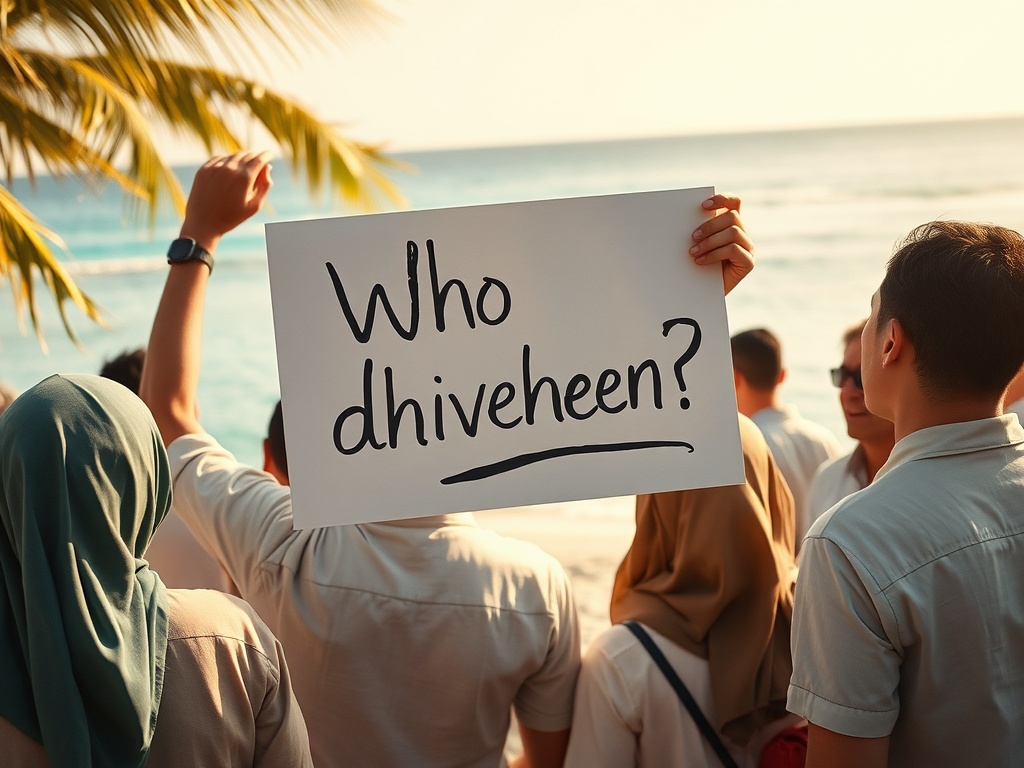
The Poster That Asked 'Who is Dhiveheen?' and Was Taken Down
The poster was respectful, the question simple: "Who is dhiveheen?" Yet its removal from a public gathering at Artificial Beach last night felt like more than just an administrative decision. It was a metaphor for a nation grappling with the very definition of its people, where the space for asking fundamental questions appears to be shrinking even as constitutional protections grow more elaborate.
Across the Maldives, a quiet tension simmers between the letter of the law and the experience of citizenship. We have crafted what might be the world's most comprehensive constitution on paper—a document filled with beautiful guarantees and progressive ideals. Yet this magnificent framework often fails to translate into tangible protections for ordinary people. The basic right to hold a respectful sign in a public space, to question what makes someone truly Maldivian, becomes contested territory.
This isn't merely about one poster or one gathering. It reflects a broader pattern where rights feel increasingly conditional, where certain groups find themselves relegated to secondary status despite constitutional assurances of equality. The term "RT"—once merely administrative—has become a marker of differentiation, creating invisible boundaries within a population that should be united.
Consider the treatment of those who have married Maldivians and raised Maldivian children, yet find themselves treated as perpetual outsiders. Or the silent acceptance of policies that appear discriminatory, met with resignation rather than resistance from those who could effect change. The expectation that people will remain silent has become so normalized that the act of questioning itself feels radical.
What makes this particularly poignant is that these conversations are happening against the backdrop of genuine national challenges—housing shortages, economic pressures, healthcare inadequacies. Yet instead of uniting citizens around shared solutions, we're dividing them through questions of belonging. The energy spent determining who qualifies as "dhiveheen" might be better directed toward building a society where all who call these islands home can thrive.
The removal of a poster is a small act, but it speaks to larger concerns about the health of our democracy. When public spaces cease to be truly public, when respectful inquiry is treated as threat rather than dialogue, we risk losing something fundamental. The constitution can enumerate rights, but it cannot breathe life into them—that requires a collective commitment to making its promises real for every person who calls these islands home, regardless of how we define the boundaries of belonging.
— Source fragments: Can we ask why was the poster someone was holding in the crowd removed last night? This is 'dhiveheenge raajje' but who is dhiveheen then? Are we not? Define your people or your tribe? I thought we all are Maldivians. We have so many Acts, maybe Maldives has the most largest and big, beautiful constitution in the world. But it cant enforce any of it. We should consider people who have married Maldivians and have kids. They are treated like aliens. Anyways as a labeled RT our rights are not secondary, we too have rights.