The Same Skyline Seen From Two Different Ferries
The ferry rocked gently as it approached Malé's harbor, the city's silhouette growing sharper against the evening sky. Ahmed watched the familiar skyline emerge, the same view he'd seen countless times returning from his island in Laamu Atoll. Yet today, the sight felt different—charged with questions that had been simmering in him for weeks.
He remembered his grandfather's stories of traveling between islands when the only borders were the horizon lines. "We were all vazanverin," the old man would say, using the ancient term for islanders. "The sea connected us, it didn't separate us."
But Ahmed was learning that modern Maldives had drawn new lines—invisible ones that determined who deserved what, who belonged where. Just yesterday, his cousin in Malé had received notification of a land plot allocation. Ahmed had applied through the same system from Laamu, but received only silence. They lived under the same government, paid the same taxes, breathed the same salt air, yet the system saw them differently.
Walking through Malé's crowded streets later, Ahmed noticed how the city seemed to be building upward and outward simultaneously. New reclaimed land stretched where fishing boats once anchored. He overheard conversations in tea shops—people debating who deserved these new spaces, whether Malé residents had greater claim to the capital they'd built, whether atoll islanders were being pushed to the margins.
At the harbor, he met Fatima, a teacher who'd moved from Huvadhoo Atoll. "They call us all Maldivians," she said, watching the sunset paint the water gold. "But when resources are distributed, suddenly we're from different categories. As if the ocean between our islands runs deeper in some administrative ledger."
Ahmed thought about the floating homes he'd seen moored in the lagoon—dream spaces for some, impossible fantasies for others. He remembered his application for housing, the way the forms asked not just about income or need, but about permanent address, about connections to the capital.
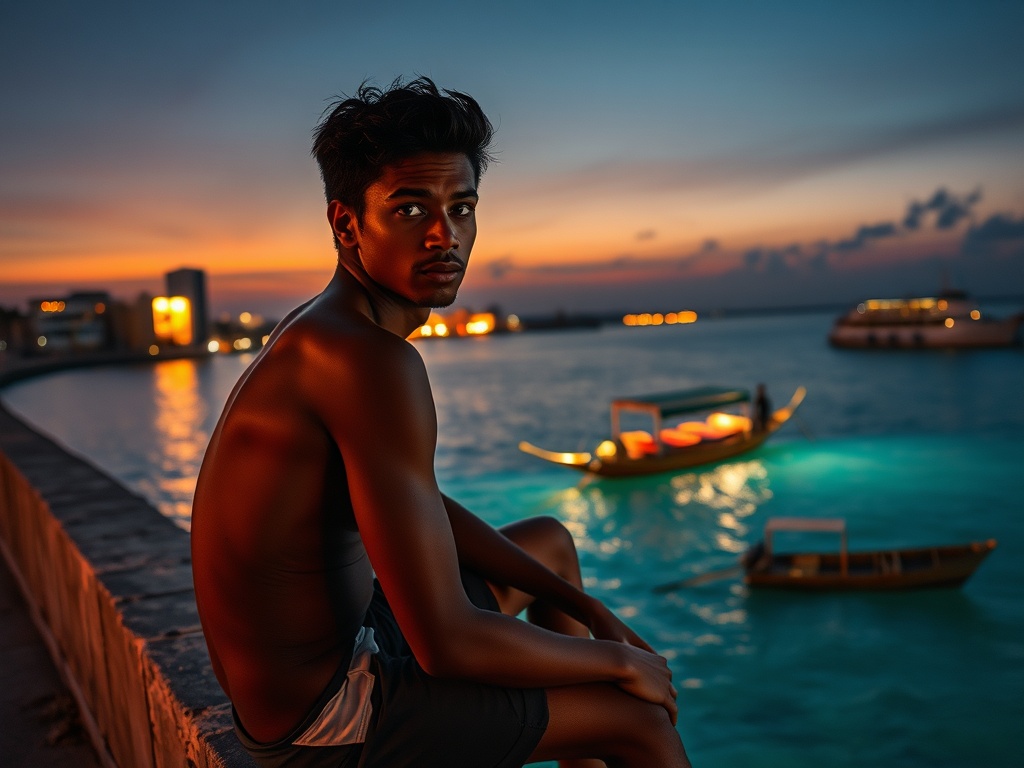
That night, sitting on the seawall, Ahmed watched the lights of Malé reflect on the dark water. The same moon that rose over his home island in Laamu shone here too. The same stars that guided fishermen across all atolls twinkled above the capital. He wondered when we started believing some stars shone brighter for certain addresses, when we decided the same moon cast different shadows depending on which patch of sand you called home.
The real borders, he realized, weren't drawn on maps or marked by coral reefs. They were drawn in policies, in whispered prejudices, in the unspoken hierarchies that determined who could build where, who could dream what. And as the night deepened, Ahmed understood that until we acknowledged these invisible lines, we could never truly cross them.
— Source fragments: Malé supremacy will ruin rest of Maldives; Malé person should have same rights as RT person; You cannot be discriminated against as a vazanveriya of Laamu atoll; Why is there special treatment for you?; Discriminatory policy; All falhus around Malé belongs to elite Malé