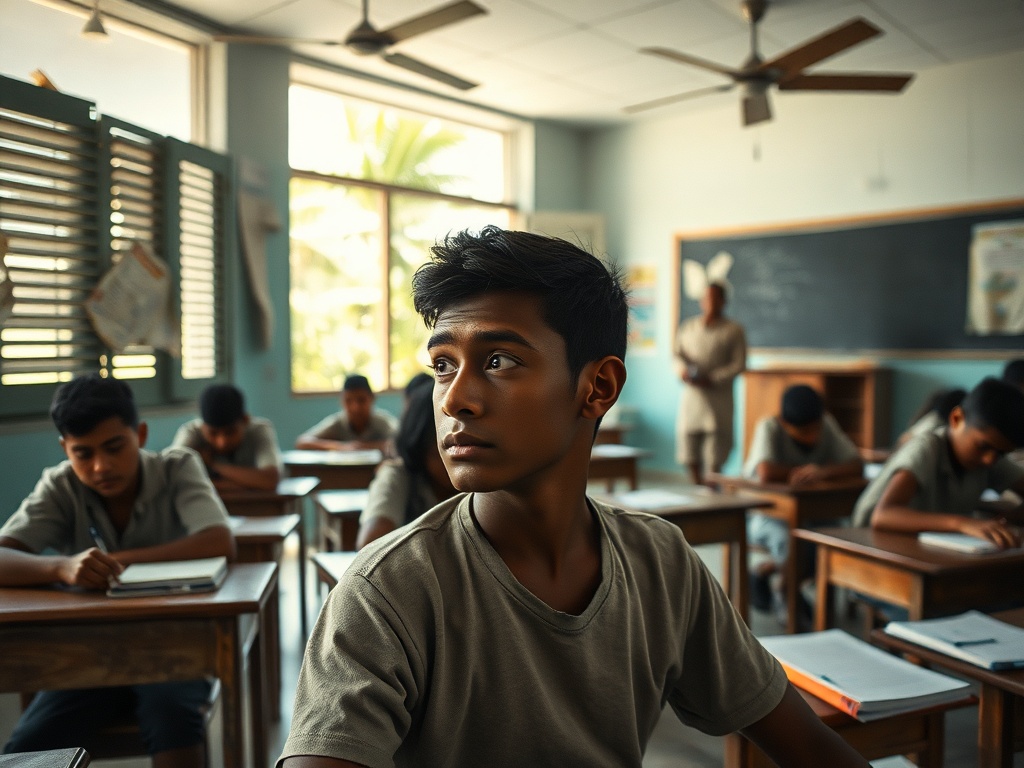
The Student Staring Out the Window While the System Fails
Across the Maldives, a quiet crisis is unfolding in classrooms and homes. The debate over educational requirements—whether O-levels should suffice or A-levels must be compulsory—masks a deeper problem: an authoritarian schooling system that fails our children during their most crucial developmental years. While policymakers argue about academic benchmarks, parents and educators witness the human cost of an approach that values conformity over curiosity.
The system's flaws begin early. A seven-year-old performing a nursery rhyme becomes a celebrated achievement, while by age twelve, many children have already lost their natural enthusiasm for learning. This isn't accidental—it's the product of an educational framework that prioritizes superficial markers over substantive growth. The recent criminalization of professional homeschooling represents an extreme extension of this control, tearing families apart under the guise of standardization.
In Addu and beyond, what's marketed as educational reform often amounts to systematic dismantling. Schools are being stripped of their guiding principles, creating chaos within institutions already stretched to their limits. The consequences are visible in rising rates of self-harm among children, often going unnoticed by parents struggling to navigate the system's complexities. Exhausted teachers, overwhelmed by systemic pressures, sometimes vent their frustrations on the very students they're meant to nurture.
The cycle perpetuates itself. Students resort to unconventional methods to survive—some credit social media tutorials for helping them pass essential subjects like Dhivehi when traditional instruction fails. This speaks to a system where success often comes despite the education provided, not because of it.
What emerges is an education ecosystem disconnected from the realities facing Maldivian youth. While the country grapples with unemployment, drug abuse, and limited opportunities, our schools prepare students for examinations rather than for life. The focus on compulsory requirements misses the fundamental issue: we're not just debating educational levels, we're questioning whether the system itself serves any meaningful purpose in preparing the next generation for the complex challenges ahead.
The solution requires looking beyond curriculum mandates to address the emotional and developmental needs of students. It demands recognizing that true education nurtures critical thinking, resilience, and creativity—qualities that cannot be measured by standardized tests alone. Until we transform our approach from authoritarian control to supportive guidance, we risk losing another generation to a system that values compliance over capability.
— Source fragments: Minimum o levels is enough; We dont need to make it compulsory for alevels too; Our most crucial learning years are wasted in a government-imposed authoritarian schooling system; In Maldives, a 7 year old dancing to a baby rhyme is considered a major achievement; By 12 many children are still; She championed a law which criminalized professional home schooling; The education system in Addu is being slowly and covertly being dismantled; Vicious cycle. Self harm in kids are raising and parents dont even realise it; Teachers in schools are exhausted and venting it out on kids