Twenty-Four Thousand Rufiyaa for Someone Else's Peeling Paint
The morning call to prayer echoed through the narrow alleys of Malé, but Ahmed heard it through the thin walls of an apartment that would never be his. Twenty-four thousand rufiyaa every month for the privilege of watching someone else's paint peel. His parents had left Fuvahmulah in the 80s, chasing opportunity in the capital. Now he was born of Malé, raised in Malé, yet the system saw him as belonging nowhere.
At the housing office, the clerk barely looked up. 'Not eligible for Malé housing because your registered island is Fuvahmulah. Not eligible for Fuvahmulah because you don't live there.' The circular logic felt like being caught between tides—pulled in two directions but going nowhere.
He remembered his grandfather's stories of Fuvahmulah, of land that knew your footsteps, of mango trees planted by ancestors. That inheritance felt like a myth now, a deed somewhere in bureaucratic limbo while he paid rent for a concrete box that grew smaller each year.
Down at the harbor, fishermen prepared their dhonis for the day's work. They moved with the certainty of men who knew where they belonged. Ahmed watched them and thought about the policy makers in their air-conditioned offices, the ones who already had Hiya flats and family homes, collecting housing 'like temple run' while ordinary people waited for solutions that never came.
His friend Rashid had gotten a job offer in Addu last year. 'Imagine,' Rashid had said, 'buying a house, living there for your contract, then selling and moving back north when you're done.' But the system didn't allow for such mobility. It was feudal, tying people to land they couldn't access, to islands they couldn't return to.
The sun climbed higher, heating the coral stone buildings until they shimmered. Ahmed thought of the thousand islands scattered across the ocean, many empty, many reserved for resorts or politicians while people like him remained suspended between the sea of their heritage and the concrete of their reality. He wasn't asking for special rights—just what every Maldivian deserved: a place to call their own, not this perpetual renting of life.
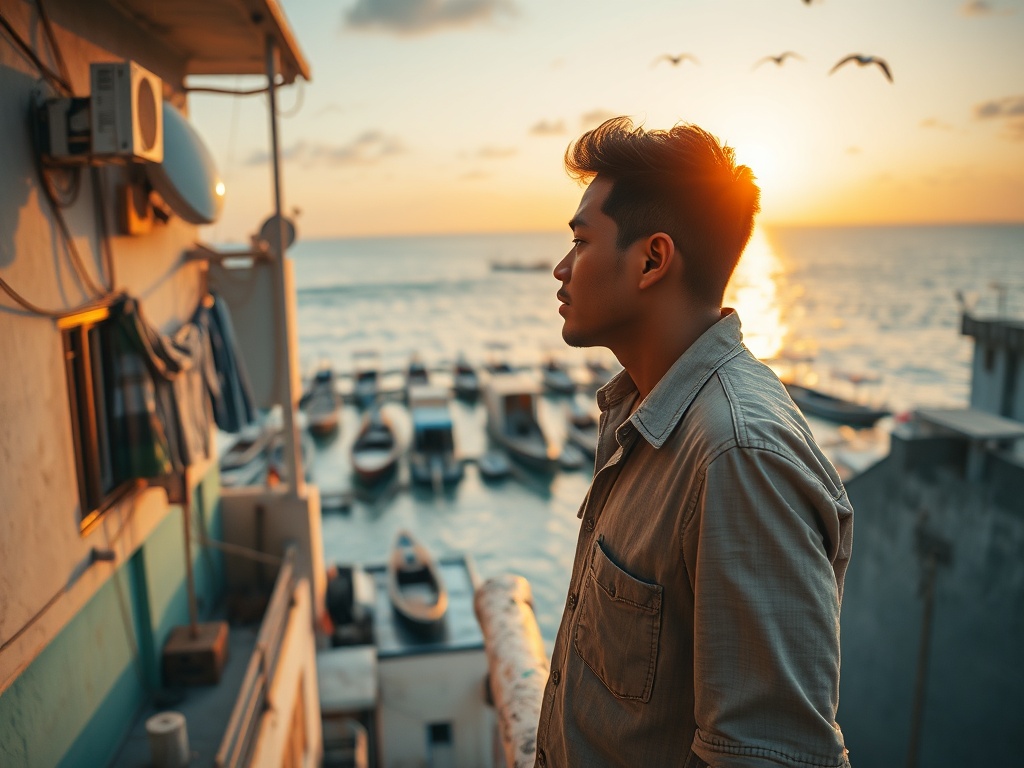
That evening, as the last light caught the minarets, he stood on his rented balcony watching the sea. Somewhere out there was his inheritance, his belonging. But for now, he was stuck in the land between tides, waiting for a system that saw citizens as people, not problems.
— Source fragments: currently we are stuck with land we are born in; paying 24k for rent to an apartment which will never be mine; My inherited land?; where do I belong? That's how a broken system creates second-class citizens; people who already have housing are taking advantage; I want every Maldivian to get free land