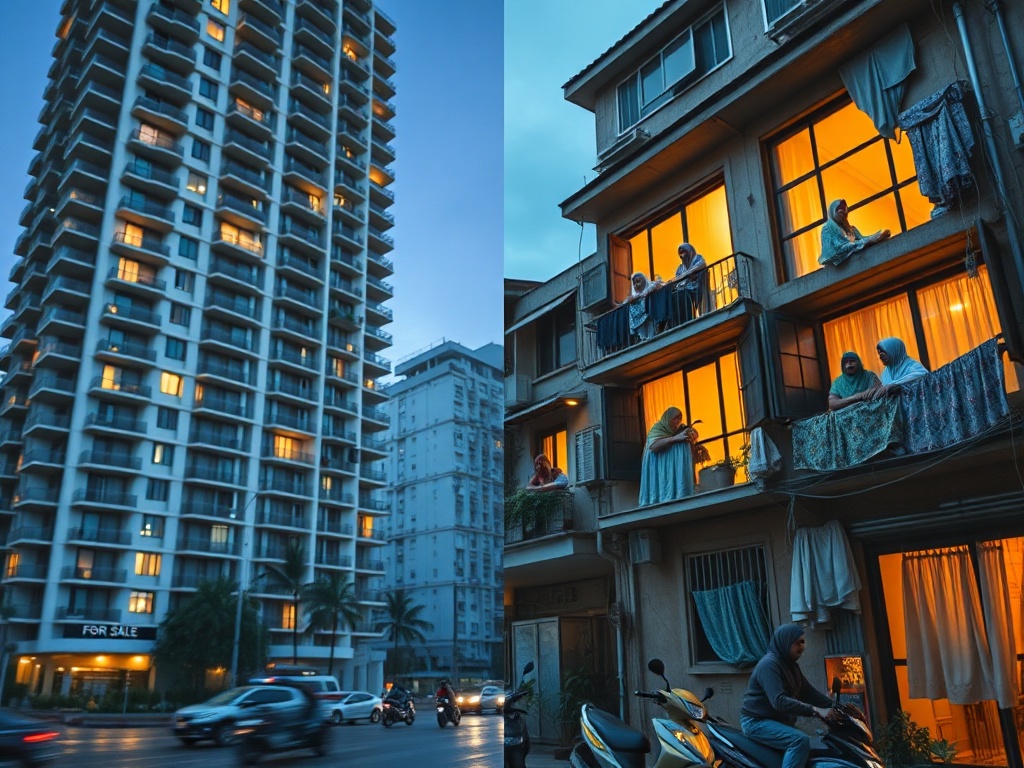
Two Families, One Kitchen, No Apartment Key
The concrete landscape of Greater Malé tells two stories. One is of gleaming new developments and land allocations, the other of overcrowded homes where multiple families share cramped spaces, their dreams of ownership receding with each passing year. This dichotomy lies at the heart of Maldives' most pressing social crisis—a housing emergency that pits community against community while failing to serve any adequately.
At the core of the debate is the allocation of land in Hulhumalé Phase 2, where the original intent of providing housing solutions has been undermined by a secondary market. Plots intended for homes are now appearing on online marketplaces, suggesting that for some, these allocations represent investment opportunities rather than shelter needs. This diversion from public purpose to private gain echoes historical patterns where opportunity appears reserved for those with existing advantages.
The mathematics of survival in Malé has become brutal. Where 5,000 to 10,000 Rufiyaa might represent fair market rates for two or three-bedroom apartments, residents instead face demands of 16,000 to 24,000 Rufiyaa—figures that consume unsustainable portions of household income. This rental crisis disproportionately affects those without property ownership, creating a permanent class of rent-burdened citizens whose monthly payments enrich landlords while leaving them no closer to ownership.
The government's contradictory approach to regulation exacerbates the problem. While authorities fix taxi rates and intervene in other markets, they claim helplessness when facing the rental crisis. This selective intervention raises questions about political will and priorities, particularly when subsidized housing units meant for low-income families are instead rented at premium prices.
For native Malé residents, the crisis carries particular bitterness. Many have lived their entire lives within the capital's confined space, watching as land allocations bypass those with deepest roots. The argument that others were 'forced' to come to Malé meets the counter-argument of those born into overcrowded family homes, sharing rooms with parents and siblings while aunts and uncles occupy adjacent spaces with their own families.
Proposed solutions range from radical depopulation strategies to more targeted interventions. Some argue for prioritizing Malé natives in housing allocations, while others call for massive investment in outer islands to reduce pressure on the capital. What remains clear is that current approaches are failing to address the fundamental inequality at play—the distinction between those for whom property represents opportunity and those for whom it represents the basic right to shelter.
The housing crisis ultimately reflects broader questions about belonging, equity, and the social contract in modern Maldives. When the roof over one's head becomes either an investment vehicle or an impossible dream, the very fabric of community begins to fray. Until policies address both the immediate need for affordable housing and the deeper patterns of allocation and opportunity, Malé will remain a city divided between those building equity and those simply trying to keep a roof over their heads.
— Source fragments: Hulhumalé Phase 2 land sales on secondary markets; rental prices ranging from 5k-24k; overcrowded living conditions in Malé; debate between native rights vs. migrant needs; government regulation inconsistencies; intergenerational housing deprivation