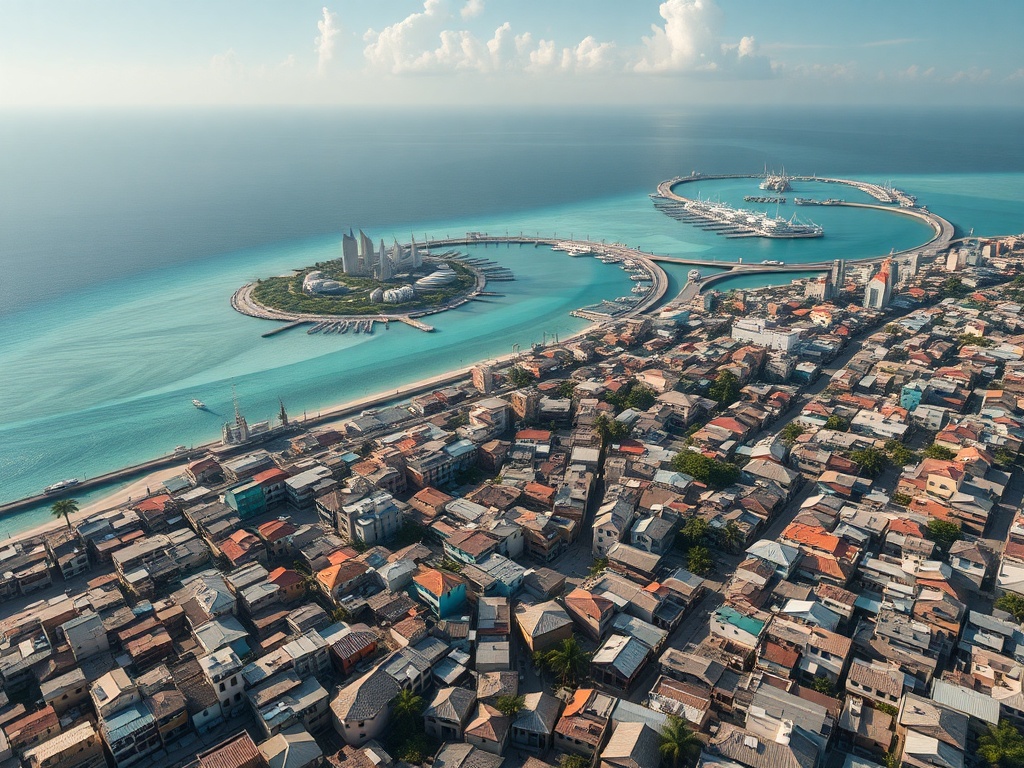
Two in Five Maldivians Now Live in Malé's Gridlock
The debate over Malé's future has reached a critical juncture. With nearly two in five Maldivians now living in the capital, the strain on infrastructure, housing, and quality of life has sparked urgent discussions about alternative urban models. The conversation reveals a nation grappling with its identity while seeking practical solutions to overcrowding.
The core tension lies between Malé's historical significance and the practical realities of modern urban planning. As one of the world's most densely populated cities, the capital cannot simply continue absorbing population growth. Yet the emotional and cultural attachment to this ancient island runs deep, making complete depopulation unthinkable.
Recent government initiatives like the RasMalé project represent ambitious attempts to address the housing crisis. The development, spanning over 123 million square feet with significant residential allocation, aims to accommodate approximately 30,000 people who missed out on previous housing schemes. While such projects offer immediate relief, they also raise questions about long-term urban strategy.
The discussion has evolved beyond simple relocation to encompass more sophisticated urban planning concepts. Some propose creating specialized satellite cities—an expatriate island to reduce congestion, or developing four additional urban centers mirroring Malé's economic functions across the archipelago. Others suggest moving the administrative capital while maintaining Malé as the financial hub, drawing inspiration from international models like Ankara, Brasilia, and Indonesia's planned Nusantara.
Migration patterns reveal complex realities that challenge one-size-fits-all solutions. Data shows unequal distribution from different atolls, with Gaafu Alif and Gaafu Dhaalu particularly noteworthy for their high migration rates to the capital. This underscores the need for region-specific development strategies rather than blanket approaches.
The permanent residency system adds another layer of complexity to the urban planning puzzle. Rather than fighting existing frameworks, some argue for reforming residency requirements while simultaneously developing alternative urban centers that can compete with Malé's appeal.
What emerges from these conversations is recognition that no single solution will suffice. The path forward requires a multi-pronged approach: creating cities with genuine economic opportunities, quality schools, and healthcare facilities that can attract families seeking cleaner, healthier environments while preserving the unique island lifestyle that defines Maldivian identity.
The challenge extends beyond physical infrastructure to changing deeply ingrained perspectives about where opportunity lies in the Maldives. Success will depend on building not just structures, but communities that offer the jobs, education, and quality of life that can genuinely shift migration patterns over generations.
— Source fragments: RasMalé project details, expat island proposal, administrative capital relocation suggestion, migration statistics from specific atolls, permanent residency system discussion, quality of life concerns for families