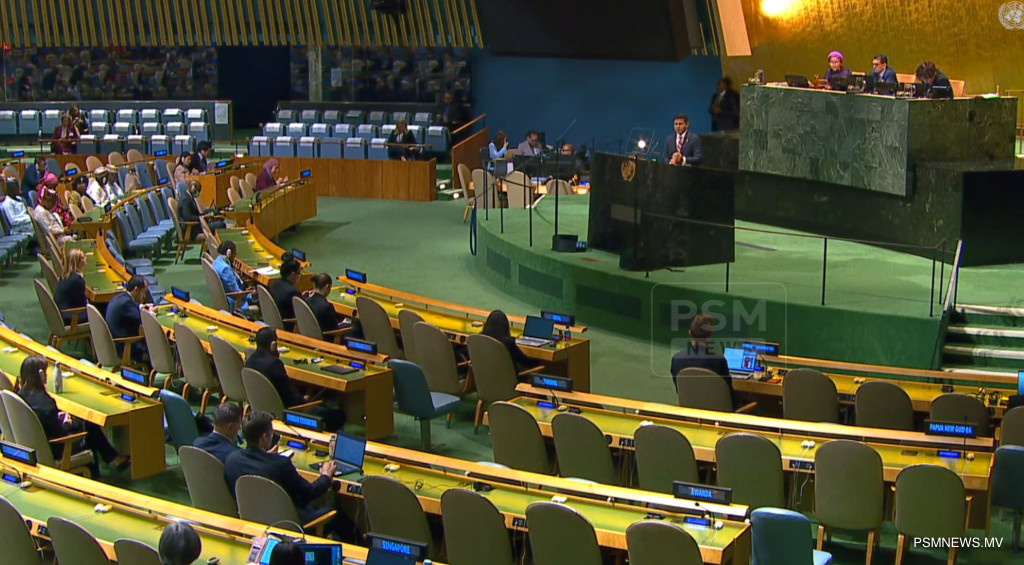
Vice President Demands UN Security Council Reform to Empower Small Island States
Vice President Hussain Mohamed Latheef has called for a comprehensive overhaul of the United Nations Security Council, arguing that the body must evolve to reflect the modern world and grant small states a decisive role in global governance.
Addressing the 81st session of the UN General Assembly, the Vice President asserted that the Council cannot continue to operate under a framework established in 1945. He proposed expanding both permanent and non-permanent categories, specifically calling for increased representation for Africa and the introduction of a rotating seat for Small Island Developing States (SIDS).
Central to his proposal is the complete abolition of the veto power held by the five permanent members. Latheef framed this reform as a necessity for sovereignty, stating that small states must transition from being "decision-takers" to "decision-makers."
The Vice President highlighted how the nature of global threats has shifted since the Maldives first raised concerns about state vulnerability four decades ago. He noted that insecurity now permeates sea lanes, digital networks, and financial markets, meaning sovereignty can be undermined without a physical border ever being crossed.
This push for reform is tied to a broader Maldivian demand for the equal application of international law. Latheef argued that no state should be shielded from accountability through political alliances or power, citing the conflict in Gaza as a critical example where international institutions must act consistently regardless of the parties involved.
“Who sits at the table shapes what the table sees,” the Vice President remarked, emphasizing that the priorities of small states—such as climate change, maritime security, and debt—are often overlooked by larger powers.
To translate these views into action, the Maldives is actively seeking seats on the UN Economic and Social Council (2027–2029), the Human Rights Council (2028–2030), and the Security Council (2033–2034).
Turning to leadership, the Vice President called for a transparent, merit-based selection process for the next UN Secretary-General. Highlighting a long-standing glass ceiling, he stated that after eight decades of male leadership, it is time for a woman to lead the organization.
Concluding his address, Latheef reaffirmed that the Maldives' objective is to ensure every state possesses the fundamental freedom to choose its own future, free from the undue influence of external powers.